
Building product manufacturers occupy a crucial position in the construction supply chain—they control quality at the source, manage production timelines, and determine the economic viability of architectural features that separate distinctive projects from commodity construction. When developers evaluate faux wood ceiling beam suppliers, the distinction between manufacturers and distributors becomes critical. Direct manufacturer relationships eliminate markup layers, provide access to custom production capabilities, and ensure quality control integration from raw material selection through final packaging. For builders executing multi-unit residential developments, hotel chains standardizing brand aesthetics, or commercial contractors managing repeat clients, manufacturer partnerships deliver advantages that wholesale distributors simply cannot match.
Manufacturing Process and Quality Foundations
Polyurethane faux beam production begins with resin formulation. High-density rigid polyurethane foam creates the structural core, formulated to achieve specific density targets between 25-35 pounds per cubic foot. This density range delivers adequate rigidity for spanning typical ceiling distances while maintaining the lightweight characteristic that makes installation practical. Lower density formulations sag under their own weight across 12-foot spans; higher densities add unnecessary weight without performance benefits. Manufacturers controlling their own formulation adjust these parameters for specific applications—lighter densities for short decorative accents, denser formulations for long-span structural member concealment.
Mold fabrication determines dimensional accuracy and surface texture fidelity. CNC machining creates aluminum molds from solid billet stock, capturing wood grain detail at microscopic resolution. A single mold producing 8x10 beams in 16-foot lengths represents a $15,000-25,000 capital investment. This upfront tooling cost explains why custom profiles require minimum order quantities—manufacturers amortize tooling expense across production volume. Standard profiles use molds producing thousands of beams annually, spreading tooling cost to pennies per unit. Custom work might produce 200-500 beams from a dedicated mold, requiring buyers to absorb tooling investment through higher per-unit pricing or guaranteed volume commitments.
Resin injection follows precise thermal cycles. Polyol and isocyanate components mix at controlled ratios, generating the exothermic reaction that expands and cures the foam. Mold temperature regulation affects surface detail capture and internal void formation. Too cool, and the resin doesn't flow into fine grain details. Too hot, and internal expansion creates voids that compromise structural integrity. Experienced manufacturers monitor these parameters continuously, adjusting for ambient temperature variations and raw material batch characteristics. This process control separates professional-grade beams from economy products showing surface imperfections and internal weaknesses.
Custom Manufacturing Capabilities and Limitations
Manufacturing flexibility represents a primary advantage of direct supplier relationships. Standard catalog profiles address common dimensional requirements—6x6, 8x8, 6x10, 8x12 cross-sections in lengths from 6 to 20 feet. But architectural specifications frequently call for non-standard dimensions. Historic renovation projects might require 7x14 beams matching existing timbers. Contemporary designs specify shallow 4x8 profiles creating subtle ceiling lines. Manufacturers accommodate these custom requirements by fabricating new molds, but buyers must understand the economics and timelines this customization entails.
Minimum order quantities for custom profiles typically start at 200-300 linear feet. This threshold covers tooling costs and justifies production line setup time. For a builder needing forty 14-foot custom beams (560 linear feet), the economics work. A homeowner wanting six custom beams (84 linear feet) faces either paying tooling fees that exceed beam cost or selecting from standard profiles. This reality shapes how builders and contractors approach design development—specify standard profiles wherever possible, reserve customization for visible areas where differentiation matters most.
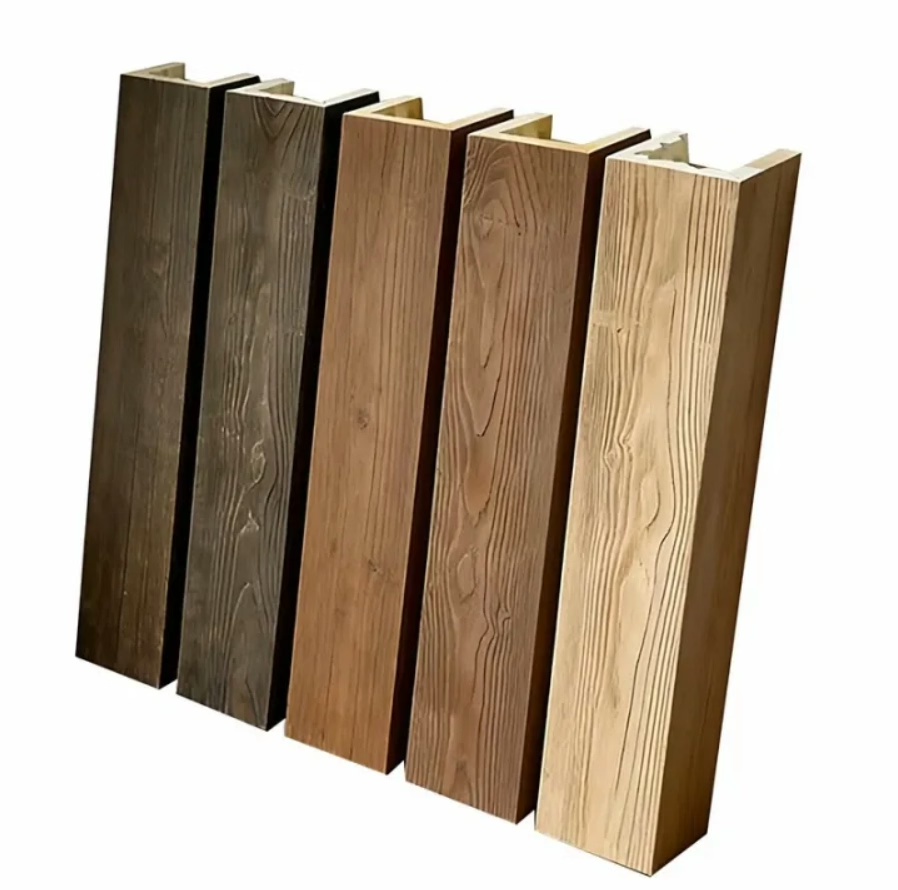
Color customization offers greater flexibility with lower minimums. Manufacturers maintain libraries of standard stain formulations—walnut, oak, weathered grey, espresso—that integrate into production without dedicated setup. Color matching to provided samples requires lab work formulating custom stain blends, but once formulated, these colors apply to any beam quantity. A 50-beam order in a custom match processes as easily as a 500-beam run. This accessibility makes color the primary customization vector for projects needing branded aesthetics or integration with existing interiors.
Texture variation happens through mold design rather than post-production hand work. Rustic textures with saw marks, adze cuts, and checking appear because the mold captures those details from master patterns. Manufacturers offering multiple texture options maintain distinct mold sets for smooth, medium, and heavy distressing within each dimensional profile. Understand that texture selection happens at the mold level—requesting heavy distressing on a smooth-mold profile requires new tooling, not a simple production change.
Bulk Order Pricing Structure and Volume Economics
Price breaks reflect manufacturing economics directly. At 100-200 linear feet, pricing includes full overhead allocation and standard margin. At 500-1000 linear feet, overhead spreads across larger volume, reducing per-foot cost by 15-20%. Orders exceeding 2,000 linear feet access tier-one pricing where manufacturers view the buyer as a strategic account rather than a transactional customer. These price tiers aren't arbitrary—they correspond to production efficiencies, container optimization, and inventory turns that make volume relationships profitable for manufacturers while delivering real savings to builders.
Payment terms scale with order size and relationship history. First-time orders typically require 50% deposit at order placement and balance before shipment. Established customers with documented payment history might negotiate 30% deposit and net-30 terms on the balance. Large developers placing recurring orders sometimes arrange open account terms with monthly invoicing. These payment structures affect project cash flow management, particularly on phased construction where beam installation occurs months after initial material deposit.
Production scheduling accommodates project timelines when manufacturers have adequate lead time. Rush orders compress normal production cycles at premium cost. Standard lead times run 3-4 weeks for stock profiles and colors, 5-7 weeks for custom configurations. Builders incorporating these timelines into construction schedules avoid rush charges and ensure material availability doesn't delay framing crews waiting for ceiling detail installation. The most cost-effective approach involves ordering when foundations pour, ensuring beams arrive during interior finish phases months later.
Quality Control Systems and Specification Compliance
Professional manufacturers implement quality systems preventing the defects that create installation problems and client complaints. Visual inspection catches surface imperfections—voids, texture inconsistencies, color variation beyond tolerance. Dimensional verification ensures beam cross-sections match specifications within 1/16-inch tolerance. Longer beams check for twist and bow that would prevent flush mounting. These inspections happen multiple times during production—after demolding, post-staining, and before packaging. Material rejected at these checkpoints gets recycled into new resin rather than shipped to customers, maintaining consistent delivered quality.
Fire rating testing provides documentation for commercial applications. Class A flame spread ratings qualify beams for assembly occupancies, educational facilities, and hospitality projects where building codes mandate low flame spread interior finishes. Testing follows ASTM E84 protocols, measuring flame spread and smoke development under controlled conditions. Manufacturers maintaining these certifications provide specification documents satisfying building department plan review. Without proper fire ratings, beams specified for commercial projects get rejected during inspection, creating costly redesign and replacement scenarios.
Structural certification documents verify non-load-bearing designation. These beams serve purely decorative functions—they don't carry roof loads or support floors. Building officials require confirmation of this limitation to prevent inappropriate structural applications. Manufacturers provide engineering letters or test reports demonstrating that beams mount to structural members rather than replacing them. This documentation protects everyone—manufacturers from liability exposure, installers from improper application, and owners from structural inadequacy.
Environmental certifications address indoor air quality and sustainable building requirements. Low-VOC formulations meet California 01350 emissions standards, qualifying beams for LEED projects and health-focused environments. Some manufacturers provide Environmental Product Declarations (EPDs) quantifying lifecycle environmental impacts. While faux beams don't earn LEED points directly, they contribute to material transparency credits and low-emitting material thresholds. Developers pursuing green building certifications verify these credentials during supplier qualification.
Supply Chain Logistics and Import Management
Most polyurethane beam manufacturing concentrates in China's Guangdong and Zhejiang provinces where resin suppliers, mold makers, and skilled finishing labor cluster. This geographic concentration creates supply chain efficiencies but requires builders to manage international logistics. Understanding these mechanisms prevents surprises and controls total landed costs.
Incoterms define responsibility boundaries between seller and buyer. FOB (Free On Board) pricing ends manufacturer responsibility once beams load onto the ocean vessel. Buyers arrange ocean freight, marine insurance, customs clearance, and inland transportation. This approach gives buyers control over logistics providers and timing but requires expertise managing multiple vendors. CIF (Cost, Insurance, and Freight) pricing includes ocean freight and marine insurance, with buyers handling customs and inland transport. DDP (Delivered Duty Paid) delivers beams to the buyer's specified location with all costs included. DDP simplifies planning but carries the highest price, as manufacturers include markup on freight and customs handling.
Container loading optimization reduces per-unit shipping expense. A 40-foot high-cube container holds approximately 2,000-2,200 linear feet of 8x10 beams depending on packaging method. Mixing profiles within a container—some 6x8, some 8x10, some 6x12—reduces total footage but allows single-shipment fulfillment of complete project requirements. Manufacturers provide container loading plans showing beam arrangement, total linear footage, and weight distribution. Ocean freight charges by container, not by weight (until density limits apply), so maximizing container utilization directly improves freight economics.
Customs classification and duty calculation affect total landed cost. Faux beams typically import under HTS codes 3925.90 or 4421.99, depending on whether customs views them primarily as plastic articles or wood imitation products. Duty rates under these classifications range from 0% to 6.5% depending on specific product determination and trade agreement applicability. Experienced customs brokers handle classification, but builders benefit from understanding these implications during supplier comparison. A 5% duty rate on a $20,000 beam order adds $1,000 to total cost—enough to affect supplier selection and project budgeting.
Manufacturer Evaluation and Supplier Selection
Not all faux beam manufacturers deliver equivalent capability and reliability. Builders evaluating suppliers should investigate several key dimensions before committing to large orders or strategic relationships.
Production capacity determines whether manufacturers can support growing builder volume. A facility operating three production lines can flex to meet surge demand; single-line operations can't scale quickly when projects accelerate. Ask about daily production capacity, typical lead times, and peak season bottlenecks. Manufacturers that can't keep pace with your growth become constraints rather than enablers.
Sample programs reveal material quality and service responsiveness. Request samples in your most common specifications—standard profiles and colors initially, then custom configurations if your projects require them. Evaluate surface finish quality, dimensional accuracy, color consistency, and packaging adequacy. Sample turnaround time indicates operational efficiency and customer service priority. Manufacturers delivering samples within a week demonstrate operational capability; those taking a month to process simple sample requests will struggle with complex production orders.
Reference customers provide ground-truth about manufacturer reliability. Ask for contacts among builders executing similar project types and volumes. Questions about order accuracy, on-time delivery, quality consistency across multiple orders, and problem resolution responsiveness reveal operational reality beyond sales promises. Manufacturers confident in their performance readily provide references; those hesitating or offering only cherry-picked contacts warrant skepticism.
Communication capability affects every interaction from initial inquiry through post-delivery support. Manufacturers serving international markets maintain English-speaking sales and technical staff who understand North American construction terminology and specifications. Time zone differences matter—suppliers with staff working U.S. business hours respond more quickly than those requiring 12-hour turnaround. Evaluate communication competence during initial contact. If simple questions generate confused responses or require multiple clarifications, complex custom orders will create frustration.
Strategic Partnership Development
The most successful builder-manufacturer relationships evolve beyond transactional purchasing toward strategic partnership. These relationships deliver advantages unavailable through casual sourcing.
Exclusive profile development creates product differentiation. Builders working repeatedly with specific manufacturers sometimes invest in custom profiles becoming their signature aesthetic. A mountain resort developer might create a hand-hewn beam profile used exclusively in their properties. The manufacturer owns the mold but agrees to exclusivity within defined markets. This arrangement gives the builder distinctive material unavailable to competitors while ensuring the manufacturer recurring volume justifying tooling investment.
Inventory consignment programs reduce builder working capital requirements. Manufacturers maintain stock of commonly ordered profiles and colors, shipping immediately when projects require material. Builders avoid inventory carrying costs and cash flow hits from advance purchases. This works best for builders with predictable, recurring needs where manufacturers can forecast demand and justify inventory risk. Not all manufacturers offer consignment, and those that do typically require historical volume demonstrating stable demand patterns.
Technical support collaboration improves project outcomes and reduces installation problems. Manufacturers experienced with their products provide installation guidance, adhesive recommendations, and troubleshooting assistance when field conditions create challenges. The best suppliers view post-sale support as integral to customer success rather than an unwanted cost center. This support becomes particularly valuable when contractors encounter unfamiliar applications—curved ceiling applications, exterior protected installations, or integration with unusual structural systems.
Conclusion
Direct manufacturer relationships for faux wood ceiling beams provide contractors and developers with capabilities and economics unavailable through distribution channels. Manufacturing process control ensures quality consistency, custom production capabilities accommodate project-specific requirements, and bulk pricing delivers real cost advantages on multi-unit projects. Understanding manufacturing constraints—tooling investment requirements, minimum order quantities, lead time realities—helps builders specify effectively and avoid costly mid-project revisions. Import logistics require attention but follow established patterns once understood. Manufacturer evaluation focusing on production capacity, quality systems, communication capability, and reference validation identifies reliable partners supporting long-term builder success. For contractors and developers building repeatedly and at scale, strategic manufacturer relationships represent competitive advantages through product differentiation, economic efficiency, and supply chain reliability that transactional purchasing cannot match.
Technical References
ASTM standards cited in every specification
Test Data
Lab results from internal testing program
Updated 2026
Reviewed against current product specs