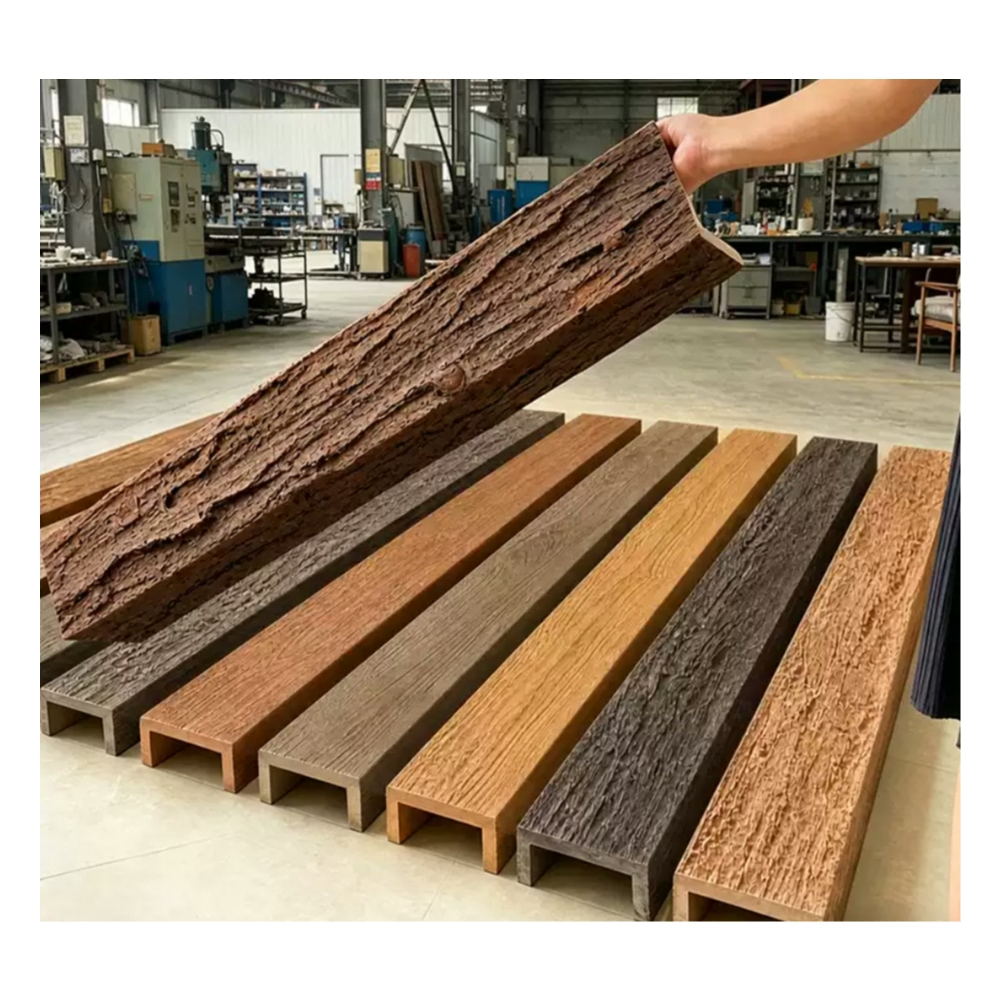
Bulk Custom Faux Wood Beams | Shipping Options to USA States
A 40-foot container of polyurethane faux wood beams represents roughly $60,000–$140,000 of finished product, sized somewhere between 1,800 and 2,400 beams depending on profile dimensions and packaging configuration. The freight decision around containers of this size is not trivial — a poor logistics choice can easily add 8–15% to landed cost through unfavorable routing, demurrage charges, or last-mile coordination failures.
For US importers working with overseas manufacturers, the shipping decision sits at the intersection of cost, speed, reliability, and final destination. There is no universal right answer. There is a process of elimination based on order size, delivery window, destination geography, and customer service expectations.
This guide covers the shipping options available, the trade-offs each option carries, and the planning considerations that determine which option is right for a given shipment.
Ocean container freight: the default for serious volume
For most bulk orders of polyurethane beams, ocean freight in a 20-foot or 40-foot container is the standard approach. The economics favor containerization, the predictability is acceptable for most project timelines, and the flexibility in final routing from the port is significant.
20-foot container (TEU). Holds roughly 800–1,000 finished polyurethane beams depending on profile. Suitable for medium-volume orders of 600–1,200 linear feet of beam product. Less common than 40-foot for beam shipments because the per-unit shipping cost is less favorable, but appropriate when destination constraints limit the unloading capability.
40-foot standard container. Holds roughly 1,800–2,400 finished polyurethane beams. The workhorse option for medium and large orders. Most US importers default to this configuration because the per-cubic-foot shipping cost is most favorable.
40-foot high-cube container. Adds one foot of interior height (9'6" vs 8'6"). Useful for longer beams (16+ feet) where standard height creates loading inefficiency. High-cube availability varies by route and season.
The decision between 20-foot and 40-foot typically depends on volume matched against destination handling capability. A job site that cannot receive a 40-foot trailer because of access constraints may force a 20-foot choice even when the volume supports a larger container.
Ocean routing options
From major manufacturing origins (China, Vietnam, Southeast Asia), the US receives ocean containers through several primary port pairs.
| Origin port | US destination port | Typical transit time | Best for |
|---|---|---|---|
| Shanghai / Ningbo | Los Angeles / Long Beach | 14–18 days | West coast destinations |
| Shanghai / Ningbo | Oakland | 15–19 days | Northern California, Pacific Northwest |
| Shanghai / Ningbo | New York / New Jersey | 28–34 days | Northeast destinations |
| Shanghai / Ningbo | Savannah | 30–36 days | Southeast destinations |
| Shanghai / Ningbo | Houston | 28–34 days | Texas, Gulf Coast, South Central |
| Shanghai / Ningbo | Chicago (via rail) | 22–28 days | Midwest destinations |
| Ho Chi Minh | Los Angeles | 18–22 days | West coast, alternative origin |
The transit times above represent the ocean portion only. Total door-to-door time includes inland trucking at origin (3–7 days), port handling at destination (3–7 days), customs clearance (1–7 days, depending on broker and exam requirements), and final inland transportation (1–10 days depending on destination). For a Los Angeles delivery from Shanghai, realistic total door-to-door is 28–42 days. For a New York delivery, 42–55 days.
The customs process
Polyurethane faux wood beams imported to the US are classified under HTS code 3925.90.0000 (builders' ware of plastics, other) or in some cases 4419.90.5000 (tableware and kitchenware of wood, other) depending on the specific product and finishing. Most importers use Section 321 de minimis entry for shipments under $800 in value, but for bulk orders of finished beams, formal entry is required.
Customs clearance for beams is generally straightforward. The product is not restricted, does not require special permits for most applications, and does not face antidumping or countervailing duties. The documentation typically required includes:
- Commercial invoice with country of origin, value, and quantity
- Packing list with weights and dimensions
- Bill of lading
- Material safety data sheet (for the polyurethane composition)
- Country of origin certificate
- Any required treatment or finish certifications (GREENGUARD, fire ratings)
Working with a customs broker familiar with building product imports reduces clearance time and avoids documentation rejections. Most importers use a broker for every shipment rather than attempting self-clearance, even on straightforward shipments.
Demurrage and detention: cost exposure that is often underestimated
The single most expensive mistake importers make with container shipping is letting containers sit at the port past free time. Demurrage (charged by the shipping line for using the port) and detention (charged by the trucking company or rail for holding the container) costs vary but commonly run $150–$400 per day after free time expires.
Free time typically runs 3–7 days at the destination port for the shipping line, and 1–3 days for the trucker once the container is released. Missing those windows creates cascading daily charges that can easily add $1,500–$8,000 to a single shipment's cost.
Practical prevention strategies include pre-arranging trucking before the container arrives, maintaining backup trucking options, and communicating regularly with the freight forwarder about timing. A common operational pattern is to dispatch the inland truck to the port one day before container availability, then discharge and return within 48 hours. Discipline around this pattern matters more than any other logistical decision in container shipping.
Air freight for urgent or smaller shipments
Air freight is rarely the right answer for full container loads of polyurethane beams because the volumetric weight makes it prohibitively expensive. But for smaller shipments, replacement orders, samples, or time-sensitive small batches, air freight has a legitimate role.
Cost comparison indicative (per cubic meter):
- Ocean freight (40-foot container, full load): $80–$180 per cubic meter
- Ocean freight (LCL, less than container load): $180–$320 per cubic meter
- Air freight (standard): $1,800–$3,500 per cubic meter
For a shipment of 50 beams needed in three weeks, air freight makes sense. For a shipment of 1,500 beams needed in three months, ocean freight is the only economically viable option.
Inland transportation from port to project site
Once the ocean container is cleared, the shipment moves inland. The choice of inland mode depends on origin port and destination.
Trucking (full container load). A standard 40-foot container requires a chassis and tractor to move. Most US trucking companies handle this routinely. Rates are quoted per mile and depend on origin port region, destination city, fuel costs, and chassis availability. A typical Los Angeles to Phoenix run runs $1,200–$1,800. A Los Angeles to Denver run runs $2,000–$3,200. A New York to Boston run runs $600–$900.
Rail (intermodal). For distances over 800 miles, intermodal rail moves become cost-competitive with trucking. Container is loaded onto a rail car at the port, moved to an inland intermodal facility (Chicago, Memphis, Dallas are common), then transferred to a local truck for the final delivery. Transit time is 3–7 days longer than direct trucking, but cost savings can be 30–45% on long hauls. For destinations not directly served by rail-truck intermodal, pure trucking remains the only practical option.
Expedited ground freight. Two-person driver teams can move a container across the country in 3–4 days rather than the standard 7–10. Cost premium is roughly 60–90% over standard ground but is less expensive than air freight for shipments where time is meaningful.
State-specific considerations across the US
Each US state has subtle variables that affect beam shipments.
California. CARB (California Air Resources Board) compliance applies to building products for VOC emissions. Polyurethane beams with proper finishing systems are typically compliant, but documentation may be requested. Port of Los Angeles / Long Beach is the primary gateway, with significant congestion at peak season.
Texas. The Port of Houston is the primary Gulf Coast entry point. Texas has no statewide beam-specific regulations, but local jurisdictions (particularly Austin, Houston, Dallas) may have specific fire-rating requirements for commercial installations.
Florida. Hurricane and high-humidity considerations affect exterior beam installations. The Port of Jacksonville and Port Tampa Bay serve different markets. Florida's building codes for coastal construction require specific performance characteristics for exterior building elements.
New York and the Northeast. Port of New York/New Jersey handles most inbound volume. Local delivery in the Northeast can be complicated by urban access constraints, low-clearance bridges, and restricted delivery hours in residential neighborhoods.
Mountain and Pacific Northwest states. Ports of Oakland, Tacoma, and Seattle serve these regions. Inland trucking across mountain passes has seasonal weather implications. Winter shipping to mountain destinations should build in additional buffer time.
Southeast states. Port of Savannah serves the Southeast efficiently. Inland trucking from Savannah to Atlanta, Charlotte, or Nashville runs 1–2 days at moderate cost.
Midwest. Limited direct port access means most Midwest shipments come via rail intermodal through Chicago. From Chicago, beams reach most Midwest cities in 1–2 days by truck.

Volume thresholds and shipping mode selection
The decision logic for shipping mode generally follows volume thresholds.
| Volume threshold | Recommended mode |
|---|---|
| Sample shipments (1–3 beams) | Air freight or international courier |
| Small orders (4–30 beams) | LCL ocean + ground |
| Medium orders (30–200 beams) | LCL ocean or 20-foot container + ground |
| Large orders (200–800 beams) | 20-foot container or 40-foot container + ground or rail |
| Very large orders (800+ beams) | 40-foot container + ground, possibly multiple containers |
The thresholds vary based on per-beam volume (longer beams fill containers faster) and on destination logistics complexity (remote destinations favor fewer containers to consolidate inland transportation).
Last-mile delivery considerations
The final leg of shipment — from the inland truck's drop point to the job site or staging facility — has its own complexity profile.
Project site delivery. Requires coordination with site access constraints, working hours, and staging area availability. Most polyurethane beam deliveries can be hand-unloaded from a flatbed trailer, but a forklift or lull may be required for heavier orders or for placement in elevated staging.
Staging yard delivery. Many importers maintain or rent staging facilities near the project site. Beams are delivered to the staging yard, inventoried, and then transported to the job site in smaller batches as construction progresses. This approach spreads delivery timing across the construction schedule and reduces job-site congestion.
Cross-docking. For shipments that need to be split across multiple destinations, cross-docking through a port-area warehouse allows the container to be unloaded and redistributed to multiple destinations in different trucks. This is common for distributors serving multiple builders in a region.
Insurance, damage, and warranty handling
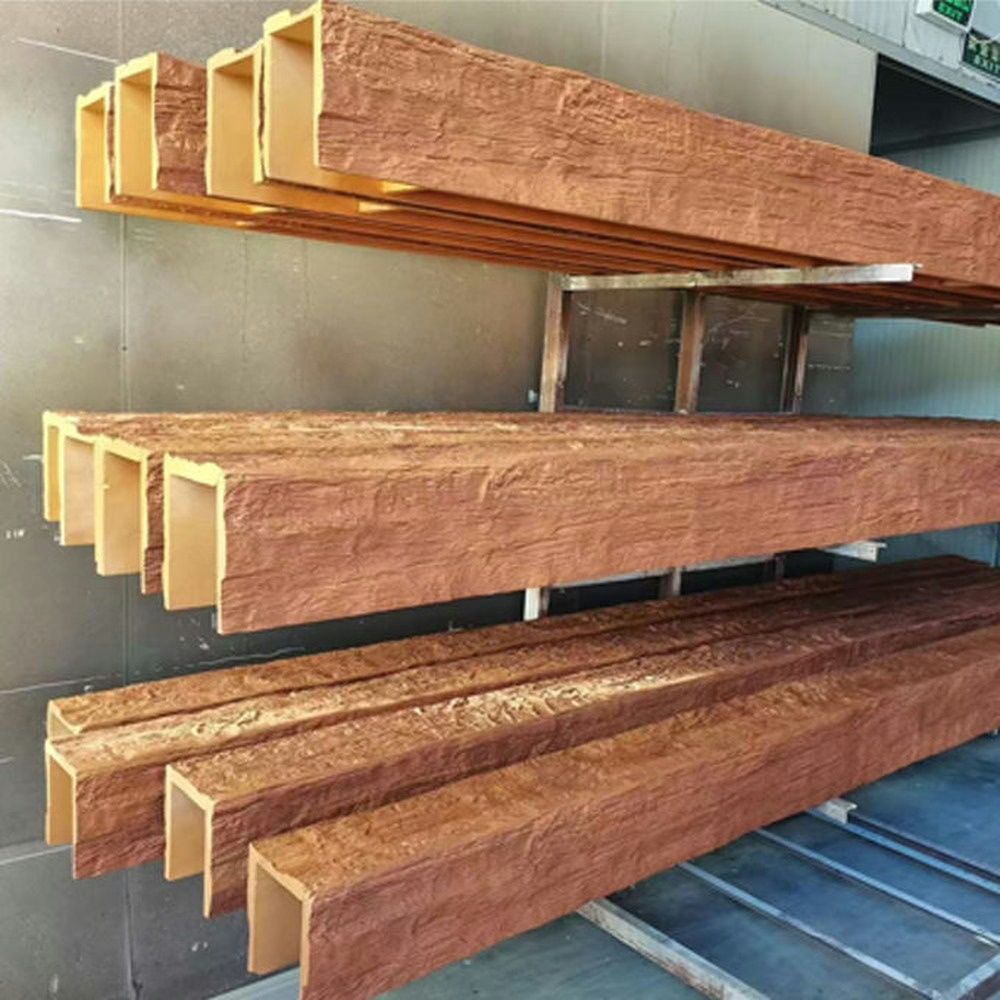
Damage in transit is rare for polyurethane beams because the material is robust and the product is typically packaged in foam-protected cartons or crating. But damage does occur, usually from container shifting during ocean transit or from inadequate blocking during inland transport.
Marine cargo insurance covers ocean freight shipments at typical rates of 0.3–0.5% of cargo value. For a $100,000 shipment, insurance runs $300–$500. Most importers consider this expense non-negotiable, particularly for finished goods that have already absorbed significant production cost.
Inland transit insurance is often carried by the trucking company at limited liability levels. Supplemental coverage is available and advisable for high-value shipments.
Damage claims must be documented at receipt. Photographic evidence of damage, noted on the bill of lading before acceptance, is essential for successful claims. Hidden damage discovered after unpacking is much harder to claim successfully.
Practical planning recommendations
For US importers planning bulk beam shipments:
Build shipping time into the production schedule. A 12-week production lead time followed by a 6-week ocean transit means total elapsed time of 18 weeks from PO to delivery. Plan backwards from project need dates with sufficient buffer.
Coordinate arrival timing with project readiness. Containers arriving two weeks before needed creates storage challenges. Containers arriving two weeks after needed creates installation delays. Match arrival with site readiness as closely as practical.
Maintain standing relationships with freight forwarders, customs brokers, and inland truckers. Rates improve and reliability increases with relationship continuity. The cost of a freight forwarder relationship more than pays for itself through reduced demurrage exposure.
Consider domestic warehousing for high-volume importers. Some importers establish domestic warehouses that hold finished inventory in stock configurations. This converts long lead times into next-week delivery for buyers, dramatically improving customer experience. The carrying cost of inventory is significant but is offset by the sales advantage of availability.
A closing note on shipping and customer satisfaction
Most buyers never think about how the beam arrived. The beam either showed up on time and undamaged, or it didn't. For wholesale importers and the manufacturers they represent, the shipping decision is invisible to the end buyer but central to whether the buyer's experience was good.
The right shipping mode balances cost and reliability against the buyer's delivery expectations. The wrong shipping mode — usually chosen for cost savings without consideration of reliability — produces the kinds of problems that damage relationships: demurrage charges passed through to the buyer, late deliveries that disrupt installation schedules, damaged product that fails on receipt.
Treat shipping as a customer experience decision, not just a logistics cost. The savings from the cheapest shipping option rarely justify the customer experience consequences when something goes wrong. The right shipping option is the one that consistently delivers on time and intact at a cost the market will support.
Technical References
ASTM standards cited in every specification
Test Data
Lab results from internal testing program
Updated 2026
Reviewed against current product specs