Choosing Faux Timber Beams for New Construction | Contractor Buying Guide
Contractors who don't regularly specify faux timber beams often face a decision they're not fully equipped to make. The supplier's catalog is full of options—stock profiles, modified profiles, custom profiles, multiple finishes, multiple colors—and the contractor has to choose without deep familiarity with how each option performs.
This is a decision framework for contractors, organized around the questions that actually determine whether a beam specification is right for a new construction project.
Question 1: Stock, modified, or custom?
The first decision is the depth of customization:
Stock profile
A profile that exists in the factory's mold library with no modification.
Choose stock when:
- The project's beam requirements are standard.
- The builder's portfolio uses consistent profiles across multiple homes.
- The timeline is tight and lead time matters.
- The budget doesn't allow for custom fees.
Tradeoffs:
- Limited profile options.
- Standard dimensions (some adjustment possible).
- Standard textures and finishes.
- Lower per-piece cost.
Modified stock profile
A stock profile modified with adjustments—different dimensions, added edge treatment, hand-detailed texture variation.
Choose modified when:
- The stock profile is close to what the project needs but not exact.
- The builder wants a distinctive look without full custom cost.
- The volume justifies the mold modification fee.
Tradeoffs:
- Higher per-piece cost (20 to 50 percent above stock).
- Longer lead time (2 to 4 weeks additional).
- Mold modification fee (one-time, $500 to $2,000).
- More distinctive look than stock.
Custom profile
A profile built from a wood master and poured into a new production mold.
Choose custom when:
- The project's design intent requires a profile that doesn't exist anywhere.
- The builder's portfolio uses the custom profile across multiple homes.
- The volume justifies the mold development cost.
- The project is high-end and the design distinctiveness matters.
Tradeoffs:
- Highest per-piece cost (40 to 100 percent above stock).
- Longest lead time (6 to 10 weeks for mold development plus production).
- Significant mold development fee ($3,000 to $8,000).
- Distinctive look that no competitor can easily replicate.
Question 2: What density?
Polyurethane density affects edge detail, weight, and cost:
Low density (80 to 150 kg/m³)
- Lighter weight.
- Lower cost.
- Softer edges; fine details may round off.
- Suitable for large beams where fine edge detail isn't visible.
Choose low density for: Standard production builder projects, beams at high ceiling locations, projects with tight budgets.
Medium density (150 to 250 kg/m³)
- Moderate weight.
- Moderate cost.
- Good edge detail for most applications.
- Standard choice for most residential and commercial projects.
Choose medium density for: Most residential projects, commercial interiors, projects with visible beams at moderate heights.
High density (250 to 320 kg/m³)
- Heavier weight.
- Higher cost (15 to 30 percent above medium).
- Excellent edge detail; crisp profiles hold their shape.
- Required for some high-end applications.
Choose high density for: Luxury homes, beams at eye level, projects with intricate profile details, applications where edge durability matters.
Question 3: What finish?
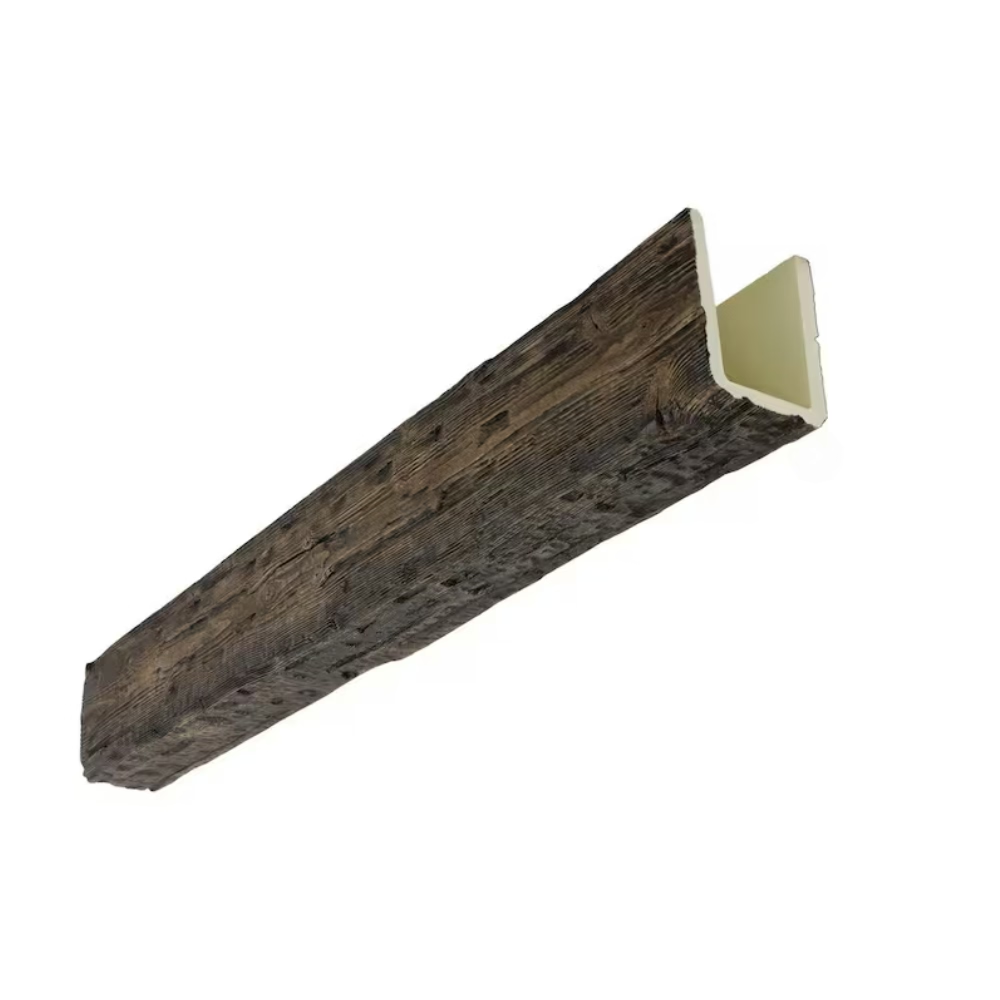
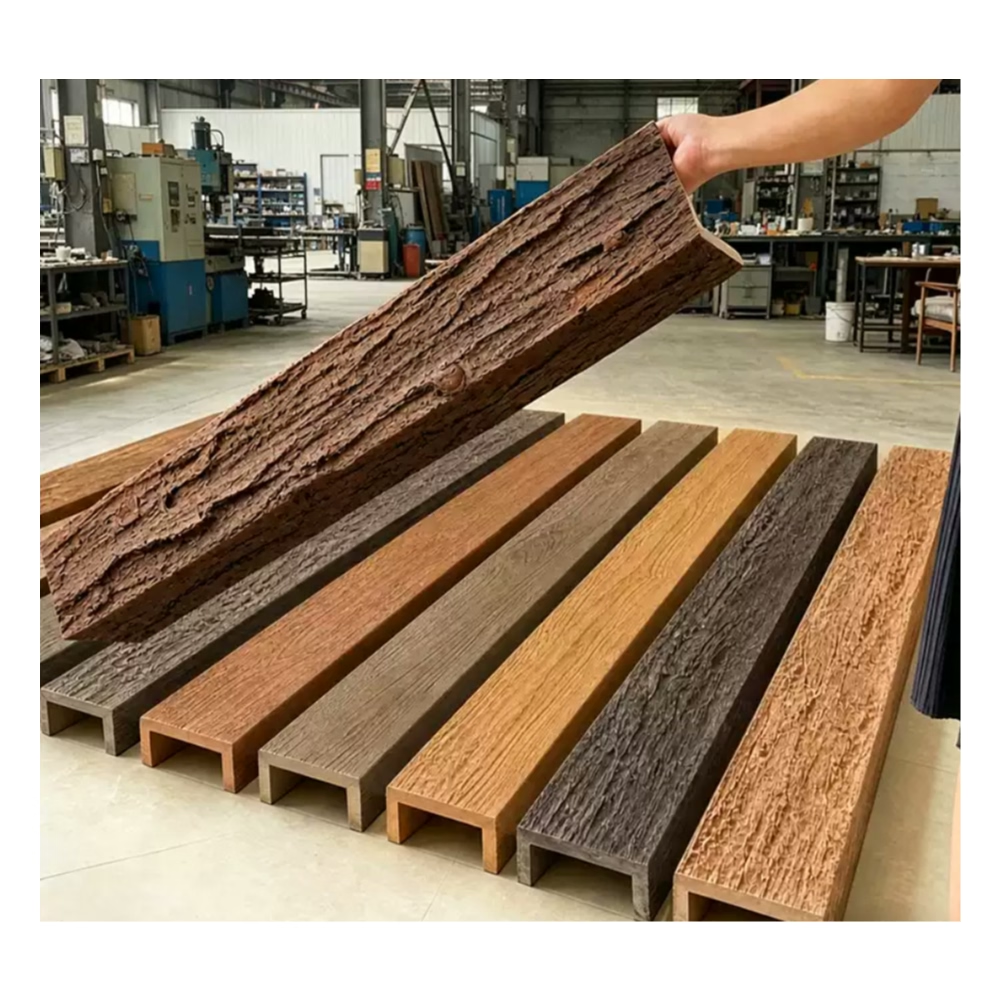
The factory finish determines the beam's appearance and durability:
Single-color flat finish
A single color applied uniformly across the beam surface.
Choose when: The design intent is simple, the budget is tight, or the beam is at a high ceiling location where detail isn't visible.
Multi-tone finish
A factory finish with multiple color tones—base color, highlight, shadow, weathering.
Choose when: The design intent includes natural wood variation, the project is mid to high-end, or the beams are at eye level where detail is visible.
Hand-applied finish
A finish applied by hand rather than by spray, with more variation and depth.
Choose when: The project is high-end, the design intent includes authentic variation, or the beams are focal elements of the design.
Unfinished
No factory finish; the beam ships with a basic sealer for on-site finishing.
Choose when: The project requires exact color matching to existing wood, the on-site finisher will customize the finish, or the budget doesn't allow for factory finishing.
Question 4: What documentation?
The documentation requirements depend on the project type and jurisdiction:
Residential projects
- Density data (for cleat holding).
- Care and maintenance guide.
- Warranty terms.
Most residential projects don't require fire rating documentation, though some local jurisdictions require it for multifamily or attached housing.
Commercial projects
- Fire rating (ASTM E84 or Euroclass).
- VOC emissions certification (often GREENGUARD or CDPH).
- Cleat specifications with engineering data.
- Seismic documentation (in seismic zones).
Commercial documentation requirements are more extensive and should be confirmed with the local building department before the order is placed.
Code-sensitive projects
- Multifamily residential.
- Healthcare.
- Education.
- Hospitality.
- Government.
Code-sensitive projects may require additional documentation, third-party testing, or specific certifications. Confirm the requirements before the order is placed.
Question 5: What cleat system?
The cleat system affects the install:
Factory-supplied cleats
Cleats that come with the beam order, sized and specified for the beam and the substrate.
Choose when: The substrate is standard (drywall, wood framing), the cleat load rating matches the project requirements, and the install will be done by a crew familiar with the cleat system.
Field-fabricated cleats
Cleats fabricated on-site by the contractor's crew.
Choose when: The substrate is non-standard (plaster, concrete, steel), the cleat specifications are unique to the project, or the factory doesn't supply cleats for the project's substrate.
Structural engineer-specified cleats
Cleats specified by the project's structural engineer, often for commercial or seismic projects.
Choose when: The project requires engineering-stamped cleat specifications, the project is in a seismic zone, or the substrate is unusual.
Question 6: What total cost?
The total cost includes more than the per-piece beam pricing:
- Beam material cost.
- Color match or finish fees.
- Mold setup fees (for modified or custom profiles).
- Cleat hardware.
- Freight.
- Install labor.
- Documentation (if separately priced).
- Replacement stock (if separately priced).
For a typical residential project, the installed cost is $20 to $50 per linear foot. For a typical commercial project, the installed cost is $30 to $70 per linear foot.
A quote that's significantly below these ranges may be missing elements. A quote that's significantly above these ranges may include premium elements that the project doesn't need.
Decision matrix for contractors
A quick-reference matrix:
| Criterion | Stock | Modified | Custom |
|---|---|---|---|
| Per-piece cost | Lowest | Medium | Highest |
| Lead time | 5-15 days | 10-20 days | 25-40 days |
| Profile options | Limited | Moderate | Unlimited |
| Setup fee | None | $500-2,000 | $3,000-8,000 |
| Minimum order | None | 100-200 LF | 300-600 LF |
| Distinctiveness | Low | Medium | High |
For most residential new construction projects, modified stock profiles are the right balance of cost, lead time, and distinctiveness. For high-end or distinctive projects, custom profiles are worth the investment.
For most commercial projects, stock or modified profiles are appropriate, with the customization focused on color, finish, and documentation rather than profile.
Common pitfalls in choosing faux timber beams
A few patterns that come up often enough to flag:
- Over-customizing. Specifying a fully custom profile for a project that would be well-served by a modified stock profile wastes budget and adds lead time.
- Under-specifying documentation. Skipping fire rating or VOC documentation to save cost creates problems at inspection.
- Choosing density based on cost rather than application. Low-density beams at eye level look cheap; the small savings aren't worth the result.
- Ignoring the cleat system. A good beam with a bad cleat system is hard to install. The cleat specification matters as much as the beam specification.
- Treating the lowest quote as the best value. The cheapest quote often has hidden costs—longer lead time, weaker documentation, less reliable replacement terms.
Choosing faux timber beams for new construction is a decision that benefits from a clear framework and discipline at each step. The right choice produces beams that meet the project's needs at a defensible cost. The wrong choice produces beams that don't quite match the design intent or that create friction during installation.
Technical References
ASTM standards cited in every specification
Test Data
Lab results from internal testing program
Updated 2026
Reviewed against current product specs