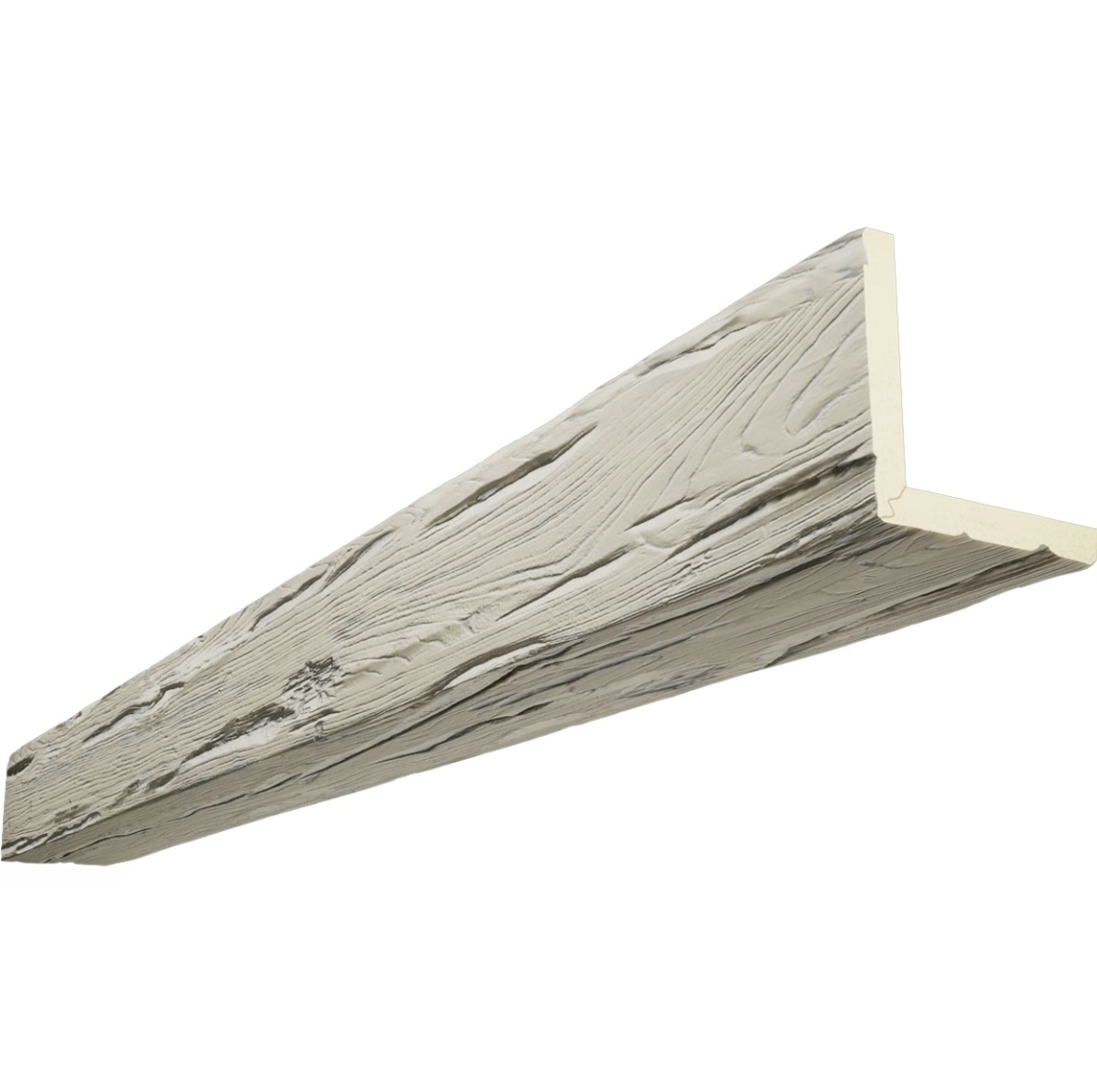
PU Decorative Faux Timber Beams | Bulk Orders Accepted for Contractors
When a faux beam supplier advertises "bulk orders accepted for contractors," the statement sounds straightforward but covers a lot of operational detail. The minimum order quantity, the deposit terms, the production scheduling, the documentation, the replacement policy—these are what "bulk orders accepted" actually means. For contractors, understanding the order acceptance policy upfront prevents friction at the procurement stage.
This is what bulk order acceptance looks like in practice, what contractors should clarify before placing orders, and how the relationship works.
What "bulk orders accepted" typically includes
For a polyurethane faux beam supplier advertising bulk order acceptance, the policy typically covers several elements:
Minimum order quantities
Most factories set minimum order quantities (MOQ) for bulk programs:
- Stock profile bulk orders: Often no MOQ beyond per-piece minimums.
- Modified stock profile bulk orders: Typically 200 to 400 linear feet.
- Custom profile bulk orders: Typically 300 to 800 linear feet.
- Custom color bulk orders: Often tied to standing specification commitment.
The MOQ reflects the factory's setup costs and production efficiency. Below the MOQ, the per-piece pricing increases significantly or the factory declines the order.
Deposit structure
Bulk orders typically require a deposit at order placement:
- Stock profile orders: 30 to 50 percent deposit, balance before shipment.
- Modified stock orders: 50 percent deposit, balance before shipment.
- Custom profile orders: 50 to 70 percent deposit, balance before shipment.
- Standing specification orders: Often net-30 or net-60 terms after initial deposit.
The deposit structure reflects the factory's working capital commitment to the order.
Production scheduling
Bulk orders are scheduled into the factory's production calendar:
- Lead time: 10 to 20 business days for stock profiles, 15 to 25 for modified, 25 to 40 for custom.
- Production slot: Reserved at order confirmation, not at inquiry.
- Rescheduling: Typically allowed up to 2 weeks before production starts without penalty.
The scheduling requires contractors to plan ahead rather than place orders at the last minute.
Documentation packages
Bulk orders typically include documentation:
- Density data.
- Fire rating documentation (for commercial orders).
- VOC emissions certification.
- Cleat specifications with engineering data.
- Care and maintenance guides.
The documentation is included in the order price, not separately charged.
Replacement stock terms
Bulk orders typically include replacement stock:
- 5 to 10 percent of order quantity held at the factory.
- Replacement lead time of 5 to 10 business days.
- Coverage period of 12 to 24 months from shipment.
The replacement stock terms protect against damage in transit, on-site storage, or during install.
How contractors negotiate bulk order acceptance
For contractors looking to negotiate favorable bulk order terms, several factors matter:
Annual volume commitment
The annual volume commitment is the most important negotiating factor:
- 1,000+ linear feet annually: 10 to 15 percent discount off standard tier pricing.
- 3,000+ linear feet annually: 15 to 25 percent discount.
- 6,000+ linear feet annually: 25 to 35 percent discount plus priority scheduling.
Contractors who can credibly commit to higher volumes get better terms.
Standing specifications
Contractors with standing specifications get better terms:
- Setup fees waived or reduced for deviations against the standing spec.
- Color match fees applied once per color, not per order.
- Replacement terms more generous for standing spec beams.
The standing specification reduces the factory's per-order setup costs.
Payment terms
Contractors with established credit history can negotiate better payment terms:
- Initial order: 50 percent deposit, balance before shipment (standard).
- After 3 to 6 months of consistent orders: Net-30 terms possible.
- After 12 months of consistent orders: Net-60 terms possible.
The payment terms reflect the contractor's payment history with the factory.
Production flexibility
Contractors who provide the factory with predictable order patterns get priority:
- Standing orders with defined delivery windows.
- Volume forecasts for the next quarter or half-year.
- Advance notice of significant specification changes.
The factory rewards predictability with better scheduling and pricing.
What bulk order acceptance means for project economics
For a contractor, bulk order acceptance affects project economics in several ways:
Per-piece cost savings
Bulk order pricing typically saves 15 to 30 percent compared to small orders:
- Small order (under 50 linear feet): full per-piece pricing plus small-order surcharge.
- Medium order (50 to 200 linear feet): standard tier pricing.
- Bulk order (200+ linear feet): bulk discount applied.
- Program order (1,000+ linear feet annually): program discount applied.
The savings compound across the contractor's project portfolio.
Production lead time
Bulk orders often have shorter lead times than small orders:
- The factory has a reserved production slot for bulk programs.
- Production scheduling is predictable.
- Replacement beams are available quickly.
For contractors running tight project schedules, the faster lead time is valuable.
Documentation depth
Bulk orders typically include more comprehensive documentation:
- Project-specific documentation packages.
- Volume-based pricing for documentation.
- Coordination with the contractor's project managers.
The documentation depth supports the contractor's project documentation requirements.
Replacement beam speed
For bulk programs, replacement beams are often faster:
- Standing inventory at the factory covers most replacement needs.
- Replacement lead time of 5 to 10 business days vs 15 to 25 for new orders.
For contractors whose projects experience occasional damage, the fast replacement keeps projects on schedule.
Common pitfalls in bulk order acceptance
A few issues that come up often enough to flag:
- Not clarifying the MOQ upfront. Contractors who order below the MOQ face pricing surcharges or order refusal.
- Insufficient deposit planning. Contractors who don't have the deposit ready when the order is placed face delays.
- Unclear production scheduling. Contractors who don't confirm production slots face scheduling surprises.
- Missing documentation requirements. Contractors who don't specify documentation needs at order placement face gaps at inspection.
- No replacement stock arrangement. Contractors without replacement stock arrangements face multi-week delays for damaged beams.
What to clarify before placing a bulk order
For contractors placing bulk orders, the questions to clarify include:
- What is the MOQ for the specific profile and finish?
- What is the deposit structure?
- What is the production lead time?
- What documentation is included?
- What are the replacement stock terms?
- What are the payment terms after the initial order?
- Can the order be rescheduled if the project changes?
These questions, answered upfront, prevent friction during the order.
PU decorative faux timber beams with bulk orders accepted for contractors is an order structure category where the operational details, the negotiation, and the relationship all matter. The right bulk order structure produces efficient procurement and predictable project economics. The wrong structure produces friction at every order.
Technical References
ASTM standards cited in every specification
Test Data
Lab results from internal testing program
Updated 2026
Reviewed against current product specs