Custom Profile Faux Ceiling Beams | What Contractors Need to Know
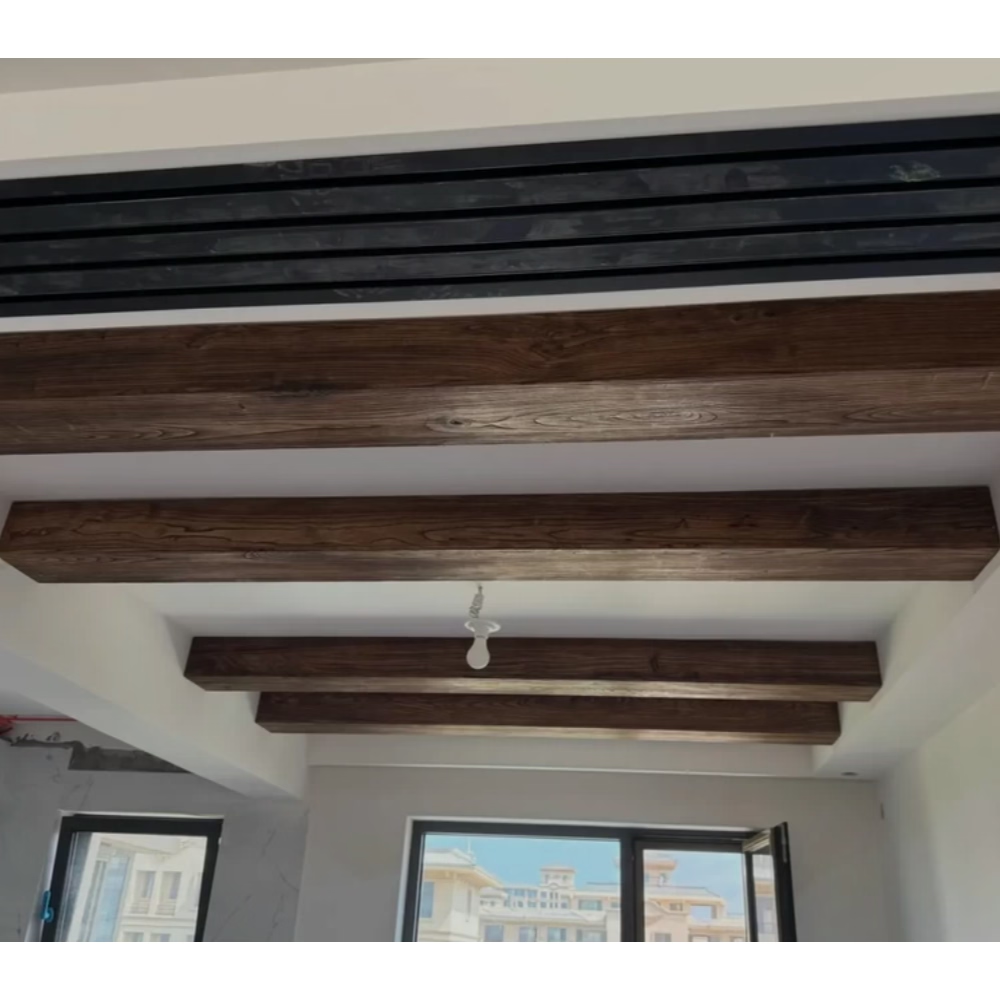
Custom profile faux ceiling beams are an option for projects requiring beam profiles beyond the supplier's standard library. The decision to specify custom profiles involves specific considerations: when custom makes sense, what the development process looks like, the cost-benefit analysis, and the practical considerations that determine whether custom is worth the investment. This article provides what contractors need to know to make informed custom profile decisions.
When custom profile makes sense
Custom profile makes sense in specific situations:
Distinctive design requirements
When the design requires a profile that doesn't exist in stock libraries:
- Architect or designer has specified a unique profile.
- The design vocabulary requires specific historical accuracy.
- The brand standard requires a distinctive profile.
- The project's design intent can't be achieved with stock profiles.
Distinctive design requirements justify custom investment.
Volume to amortize mold cost
When the volume is sufficient to amortize the mold development cost:
- 500+ linear feet of the custom profile.
- Multiple projects using the same profile.
- Long-term use of the profile.
- The mold cost is spread across meaningful volume.
Sufficient volume makes custom economically viable.
Brand differentiation
When the custom profile provides brand differentiation:
- The contractor wants a portfolio-distinctive profile.
- The developer wants a brand-specific profile.
- The hotel wants a brand-distinctive profile.
- The differentiation justifies the custom investment.
Brand differentiation supports the custom decision.
Historical accuracy
When historical accuracy requires specific profiles:
- Historic restoration projects.
- Replicating historical beam profiles.
- Period-specific design requirements.
- Authenticity requirements beyond standard profiles.
Historical accuracy justifies custom investment.
When stock profiles are sufficient
Stock profiles work for most projects:
Standard applications
When the design fits standard profiles:
- Most residential applications.
- Many commercial applications.
- Standard Spanish, Mediterranean, or other style applications.
- Designs without specific profile requirements.
Standard applications work with stock profiles.
Limited volume
When the volume doesn't justify custom investment:
- Single projects under 200 linear feet.
- One-time use of the custom profile.
- Small projects where mold cost dominates.
- Projects where stock profiles work adequately.
Limited volume makes stock more economical.
Budget constraints
When the budget doesn't allow for custom development:
- Modest project budgets.
- Cost-sensitive applications.
- Projects where the design intent works with stock.
- Budgets where mold cost is a meaningful percentage.
Budget constraints favor stock profiles.
Time constraints
When the timeline doesn't allow for custom development:
- Tight construction schedules.
- Lead times shorter than 12 weeks.
- Projects where standard lead times are already tight.
- Rush projects where custom would exceed timeline.
Time constraints favor stock profiles.
The custom profile development process
For custom profile projects, the development process involves:
Reference evaluation
The contractor provides references:
- Physical wood samples (when available).
- Historical photographs or drawings.
- Reference images showing the desired profile.
- Architectural drawings or specifications.
Reference evaluation sets the foundation for development.
Wood master creation
The factory creates the wood master:
- Skilled carver selects the wood block.
- Hand-cuts the profile per the reference.
- Adds texture details.
- Reviews against the reference.
- Refines as needed.
Wood master creation takes 30 to 80 hours of skilled work.
Sample production
The factory produces samples from the wood master:
- Polyurethane cast from the wood master.
- Color and finish applied per specification.
- Quality inspection.
Sample production takes 1 to 2 weeks.
Sample iteration
The contractor reviews samples and approves or requests modifications:
- Cycle 1: Initial profile.
- Cycle 2: Refinements based on feedback.
- Cycle 3: Final profile.
Most custom profiles require 1 to 3 iteration cycles.
Mold production
After approval, the factory produces the production mold:
- Mold pouring from the wood master.
- Mold curing.
- Mold testing with sample production.
Mold production takes 2 to 4 weeks.
Production
The factory produces the order:
- Production waves aligned to construction schedule.
- Color and finish per specification.
- Quality inspection.
Production takes 3 to 5 weeks per wave.
Cost-benefit analysis for contractors
For contractors, the custom profile cost-benefit analysis:
Costs
- Mold development: $3,000 to $8,000+.
- Per-piece pricing premium: 40 to 80 percent above stock.
- Sample development: Often included in mold fee.
- Lead time extension: 8 to 16 weeks additional.
- Designer or architect coordination time.
The costs are significant.
Benefits
- Distinctive profile not available elsewhere.
- Brand differentiation.
- Historical accuracy.
- Higher perceived quality.
- Potential for higher project pricing.
The benefits depend on the project's nature.
Break-even analysis
Calculate break-even for the mold development:
- Mold cost: $5,000 (example).
- Per-piece premium: $8 per linear foot.
- Break-even volume: 625 linear feet.
For projects under 625 linear feet, stock profiles may be more economical.
Decision criteria
The decision criteria include:
- Volume sufficient to amortize mold cost.
- Design requires distinctive profile.
- Timeline allows for custom development.
- Budget allows for custom premium.
- Brand differentiation justifies the investment.
The criteria support the custom decision.
Practical considerations for custom profiles
For contractors considering custom profiles, practical considerations:
Designer or architect coordination
Custom profiles typically involve designer or architect specifications:
- The designer provides the profile specification.
- The contractor coordinates with the factory.
- The contractor manages the sample approval.
- The designer approves the final profile.
Designer coordination is essential for custom profiles.
Sample approval management
The contractor manages sample approval:
- Reviews samples against the design intent.
- Coordinates with the designer for approval.
- Documents the approved profile.
- Authorizes production.
Sample management produces accurate results.
Cost communication
The contractor communicates with the project owner:
- The cost premium for custom profiles.
- The longer lead times for custom profiles.
- The trade-offs between custom and stock.
- The design benefits that justify the investment.
Communication supports owner decision-making.
Timeline management
The contractor manages the timeline:
- Builds custom profile lead time into the schedule.
- Coordinates with the construction schedule.
- Plans for sample iteration cycles.
- Manages production timing.
Timeline management supports project completion.
Replacement stock
For custom profiles, replacement stock considerations:
- Replacement beams available from the maintained mold.
- Same per-piece pricing as original orders.
- No setup fees for reorders.
- Coverage period (24 to 36 months).
Replacement stock is supported for maintained molds.
Common pitfalls in custom profile projects
A few issues that come up often enough to flag:
- Insufficient volume for amortization. Mold cost exceeds the per-piece savings.
- Underestimating timeline. Custom profile development time not planned for.
- Skipping sample iteration. Rushing through samples produces mismatched profiles.
- Insufficient designer coordination. Contractor doesn't engage the designer appropriately.
- Not maintaining the mold. Molds degrade without proper maintenance.
How contractors evaluate custom profile suppliers
For contractors evaluating suppliers for custom profile work:
- Wood master capability. The supplier has skilled wood masters.
- Sample quality. The supplier's samples demonstrate high-quality profiles.
- Mold maintenance. The supplier maintains molds for long-term use.
- Cost transparency. The supplier's pricing for custom profiles is clear.
- Lead time reliability. The supplier meets custom profile lead times.
- References. The supplier has done comparable custom profile work.
Quick reference for custom profile decisions
- Stock profile cost: $10 to $18 per linear foot.
- Custom profile cost: $15 to $32 per linear foot (40 to 80 percent above stock).
- Mold development: $3,000 to $8,000+.
- Lead time: 8 to 16 weeks additional vs stock.
- Break-even volume: Typically 400 to 1,000 linear feet depending on per-piece premium.
Custom profile faux ceiling beams for contractors is a category where the cost-benefit analysis, the practical considerations, and the supplier capability all need to align. The right combination produces distinctive profiles that justify the custom investment. The wrong combination produces profiles that don't quite match expectations despite the investment.
Technical References
ASTM standards cited in every specification
Test Data
Lab results from internal testing program
Updated 2026
Reviewed against current product specs