Faux Wood Beams for Hotel & Villa | Wholesale Manufacturer Supply
Hotel and villa projects look similar at first glance—both involve high-end residential or hospitality interiors, both have brand or owner specifications that drive the design, both often involve beam ceilings as a focal element. At the wholesale manufacturer level, however, the supply patterns diverge in important ways. A manufacturer serving both segments has to maintain parallel capabilities.
This is what hotel and villa projects share, where they diverge, and how wholesale manufacturer supply actually works across both.
What hotel and villa projects share
Despite the operational differences, hotel and villa projects share several characteristics that affect beam supply:
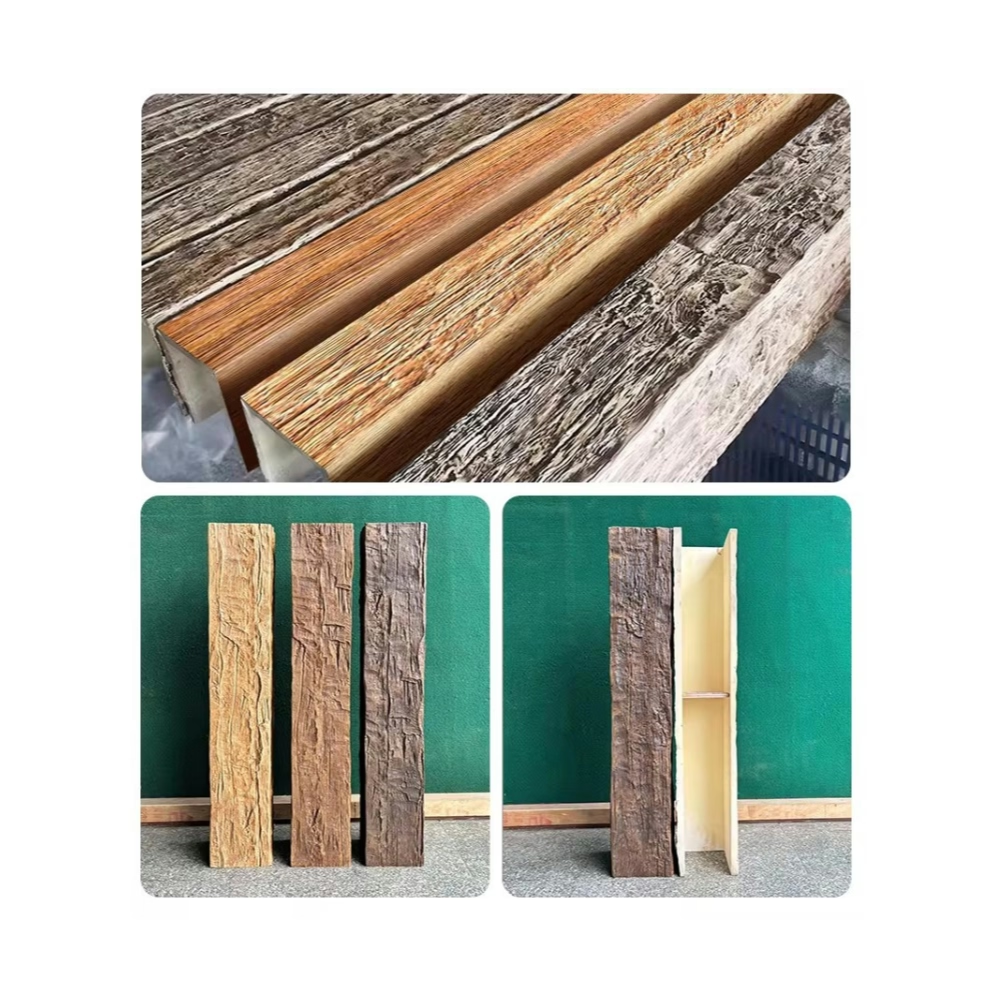
- Premium finish requirements. Both segments demand premium finishes—multi-tone factory color, hand-detailed texture, satin or higher sheen. Standard builder-grade finishes are rarely appropriate.
- Custom specifications. Both segments typically involve custom color matching, custom profile work, or both. Stock profiles may be the starting point, but the final spec is project-specific.
- Documentation depth. Both segments require documentation—fire rating, VOC emissions, cleat specifications, sometimes seismic documentation.
- Coordination with designers. Both segments involve interior designers or design consultants who drive the beam specification. The manufacturer coordinates with the designer, not just the contractor.
- Replacement stock requirements. Both segments typically require the manufacturer to hold 5 to 10 percent replacement stock for the project's duration.
For a manufacturer serving both segments, these shared characteristics mean the production capabilities overlap significantly.
Where hotel and villa projects diverge
The operational differences between hotel and villa projects affect how the manufacturer structures the supply:
Order volume and frequency
Hotel projects typically involve large order quantities, often 1,000 to 10,000 linear feet of beam, ordered in waves aligned to construction phases. A single hotel project might run 18 to 36 months from order to final delivery.
Villa projects typically involve smaller order quantities, often 200 to 1,500 linear feet of beam, ordered in one or two waves. A single villa project might run 6 to 18 months.
For a manufacturer, hotel projects produce larger, more predictable production runs. Villa projects produce smaller, more varied runs. The mix of both creates a more stable overall production schedule than either segment alone.
Specification control
Hotel projects are typically driven by brand standards. A hotel chain has a design standard that applies to all properties in the chain, with minor variations per location. The manufacturer produces against the brand standard.
This means the manufacturer needs to maintain brand-standard specifications across multiple projects, often over several years. Color consistency, profile consistency, and finish consistency are critical—any drift breaks the brand standard.
Villa projects are typically driven by the owner or the design team. Each villa has its own design intent, with the manufacturer producing against the project-specific specification.
This means the manufacturer needs to handle more variation in villa projects, with each project potentially requiring custom color, custom profile, or both.
Lead time expectations
Hotel projects typically have construction timelines that allow 8 to 16 weeks of lead time on beam orders. The brand standard and the construction schedule usually provide enough buffer.
Villa projects often have tighter timelines, particularly for private owners who want to move in. Lead time expectations of 4 to 8 weeks are common.
For a manufacturer serving both segments, the production scheduling has to accommodate both timelines. Hotel projects can be planned further in advance; villa projects often need faster turnaround.
Documentation requirements
Hotel projects typically require comprehensive documentation: fire rating, VOC emissions, cleat specifications, seismic documentation (in seismic zones), and sometimes chain-specific quality certifications.
Villa projects typically require less comprehensive documentation, though the documentation requirements for luxury villas are still significant: fire rating for any code-governed elements, VOC emissions for indoor air quality specifications, cleat specifications for the structural engineer.
For a manufacturer serving both, the documentation capabilities need to support both levels of depth.
Pricing structure
Hotel projects typically have negotiated pricing per project, often with multi-project pricing agreements for chains. The manufacturer commits to pricing for a defined volume over a defined period.
Villa projects typically have project-by-project pricing, with less negotiating leverage but more flexibility on per-project specifications.
For a manufacturer, the hotel pricing structure provides volume predictability; the villa pricing structure provides margin flexibility.
How wholesale manufacturer supply works across both
For a manufacturer serving both hotel and villa segments, the supply structure includes:
Parallel production capabilities
The factory maintains parallel production capabilities:
- Hotel-grade production. High volume, brand-standard specifications, comprehensive documentation, phased delivery.
- Villa-grade production. Lower volume, custom specifications, premium finishes, faster turnaround.
These capabilities share infrastructure (mold library, color library, cleat inventory) but have different production workflows.
Brand standard maintenance
For hotel clients, the factory maintains brand-standard specifications in active status:
- Master color references for each brand's standard palette.
- Mold status for each brand's standard profiles.
- Documentation packages for each brand's standard specifications.
The factory's project coordinator for hotel clients maintains these standards over years, often across multiple properties.
Custom specification development
For villa clients, the factory develops custom specifications per project:
- Color match against project-specific references.
- Profile work for project-specific architectural details.
- Finish variations for project-specific design intent.
The factory's project coordinator for villa clients handles this per-project development, often with input from the project's design team.
Documentation packages
The factory produces documentation packages tailored to each segment:
- Hotel documentation: Comprehensive, including chain-specific requirements. Often provided as a standard package per brand.
- Villa documentation: Project-specific, focused on code compliance and design intent. Provided per project.
The documentation team handles both, with different templates and procedures for each segment.
Pricing across segments
Pricing for hotel and villa projects reflects the different operational characteristics:
- Hotel pricing: Lower per-piece pricing due to volume, but tighter margins. Pricing is negotiated per project or per multi-project agreement.
- Villa pricing: Higher per-piece pricing due to lower volume and custom work, but better margins. Pricing is project-by-project.
For a manufacturer, the optimal mix is a balance of hotel volume (stable, lower margin) and villa margin (project-specific, higher margin). Most manufacturers serving both segments aim for 60 to 70 percent hotel volume and 30 to 40 percent villa volume, though the mix varies.
Common pitfalls in cross-segment supply
A few issues that come up often enough to flag:
- Treating villa projects as small hotel projects. The operational differences matter. A villa project has tighter timelines, more variation, and different documentation requirements than a hotel project.
- Brand-standard drift on hotel projects. The factory's brand-standard specifications need active maintenance. Drift over time breaks the brand standard.
- Inconsistent documentation between segments. The factory's documentation team needs to handle both segments without confusing them. A villa project that gets hotel-grade documentation (or vice versa) creates friction.
- Production scheduling conflicts. Hotel projects have longer planning horizons; villa projects have shorter. The factory's production scheduling needs to accommodate both without one segment starving the other.
How to structure the manufacturer relationship
For a manufacturer serving both hotel and villa segments, the relationship structure with each client type should be:
Hotel chain relationship
- Multi-project agreement with the chain.
- Brand-standard specification maintenance.
- Phased production and delivery aligned to the chain's construction schedule.
- Priority production scheduling during peak demand periods.
- Dedicated project coordinator for the chain.
Villa owner or designer relationship
- Project-by-project agreement.
- Custom specification development.
- Faster turnaround on samples and production.
- Comprehensive project-specific documentation.
- Project coordinator with design sensitivity.
For a manufacturer, maintaining both relationship types in parallel requires organizational discipline. The same factory serves both, but the workflows are different.
Faux wood beams for hotel and villa projects at the wholesale manufacturer level are a category where the parallel capabilities matter. A manufacturer with strong hotel supply capabilities and weak villa capabilities (or vice versa) will struggle to serve clients who need both. The right manufacturer has both workflows running smoothly.
Technical References
ASTM standards cited in every specification
Test Data
Lab results from internal testing program
Updated 2026
Reviewed against current product specs