Long Length PU Faux Beams | Custom 17ft+ Beams for New Construction Projects
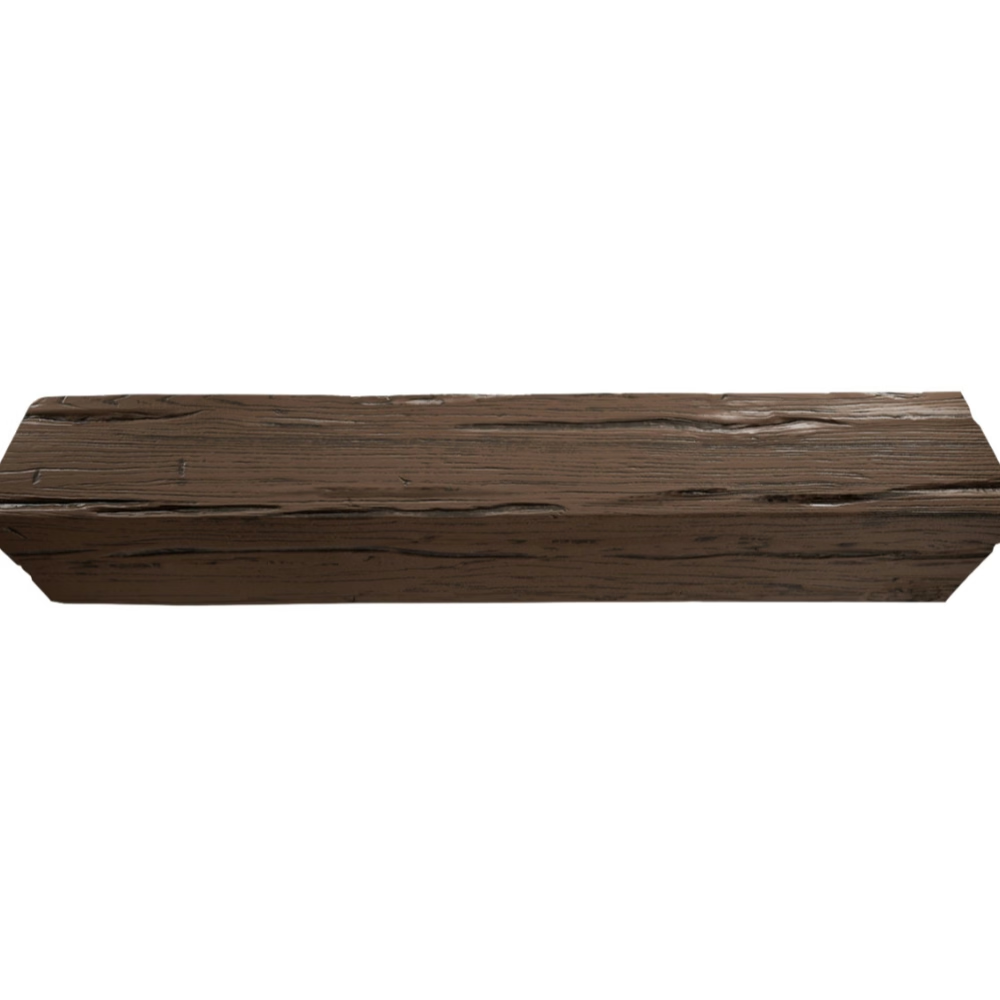
Long-span beams—anything over 16 feet—are where the practical advantages of polyurethane over real timber really show up. A solid timber beam at 20 feet is heavy, expensive to ship, and difficult to install. A 20-foot polyurethane beam of comparable dimensions is one-quarter the weight, fits in a standard shipping container, and can be installed by a two-person crew without a crane.
This is a walk-through of the engineering, the production logistics, and the field handling that makes long polyurethane beams a practical solution for new construction projects.
Why polyurethane handles long spans better than timber
The fundamental advantage of polyurethane for long spans is the weight-to-volume ratio:
- Solid timber beam at 20 feet, 8 inches by 10 inches: approximately 350 to 500 pounds.
- Polyurethane faux beam at 20 feet, 8 inches by 10 inches, 250 kg/m³ density: approximately 80 to 110 pounds.
- Polyurethane faux beam at 20 feet, 8 inches by 10 inches, 150 kg/m³ density: approximately 50 to 70 pounds.
The weight difference isn't just a convenience; it changes the structural and logistical requirements:
- No crane needed for install. A 20-foot timber beam requires a crane or a team of 6 to 8 people to lift into position. A 20-foot polyurethane beam can be lifted by 2 to 3 people.
- Standard structural support. A timber beam of that size requires engineered structural support—often a steel beam or a glulam beam behind it. A polyurethane beam can mount to standard ceiling framing with appropriate cleats.
- Standard freight. A 20-foot timber beam may require oversize load permits and specialized freight. A 20-foot polyurethane beam fits in a standard container or trailer.
- Easier field handling. The polyurethane beam can be moved on-site by hand, positioned by a small crew, and adjusted without heavy equipment.
For new construction projects with long spans—great rooms, vaulted ceilings, open-plan living areas, large commercial interiors—the weight difference is decisive.
How factories produce long polyurethane beams
Long polyurethane beams are produced differently from shorter beams:
Mold capacity
Most polyurethane beam molds are designed for production lengths of 8 to 16 feet. For beams longer than 16 feet, the factory uses one of three approaches:
- Extended molds. Some factories have molds specifically designed for long beams—up to 24 or even 28 feet. These are larger and more expensive than standard molds, and the production rate is slower.
- Pour-and-extend. The factory pours a standard-length beam and extends it with a secondary pour at one or both ends. The extension is bonded to the original pour with a structural adhesive, and the joint is hidden in the texture.
- Multi-piece assembly. The factory produces the beam in two or more pieces that are assembled at the factory or on-site. The pieces are designed to join invisibly.
For very long beams (over 20 feet), the multi-piece approach is most common. The joint is designed to be invisible from below after install.
Texture consistency across long spans
Texture consistency is a particular challenge for long beams. The mold texture is uniform across its length, but if the beam is produced in two pieces with a joint, the texture must match across the joint. The factory's process for this:
- The mold texture is documented. The factory has a detailed reference of the mold's texture pattern, including any variation along the length.
- The joint location is planned. For a 22-foot beam produced in two pieces, the joint typically lands at a point where the texture pattern is least visible.
- The texture is hand-finished at the joint. The factory's texture artist touches up the joint area to ensure continuity.
For very long beams where the joint is unavoidable, this hand-finishing step is what makes the difference between a joint that's visible and one that disappears.
Factory finish consistency
The factory finish also has to be consistent across the joint. For a satin finish with multi-tone variation, the finisher works across the joint to ensure the color and sheen match. This is more labor-intensive than for shorter beams, which is part of why long beams carry a price premium.
Transport and logistics for long beams
Transporting long polyurethane beams requires planning:
Domestic transport
For domestic shipments (within the continental US, Canada, Mexico), long beams are typically crated and shipped on standard flatbed trailers. Beams up to 24 feet fit on a 48-foot trailer without permits. Beams over 24 feet may require oversize load permits, depending on the state.
For a typical new construction project with 20 to 40 long beams, the shipment is usually one to two trailer loads.
Export transport
For export shipments (which is most of the volume for this product category), long beams are containerized in 40-foot high-cube containers:
- Container dimensions: 40 feet long, 8 feet wide, 9.5 feet tall.
- Beam length capacity: Beams up to 39 feet can fit in a 40-foot container, but practical limits are usually 20 to 24 feet for safe handling.
- Loading pattern: Beams are loaded horizontally, often in custom cradles that hold them securely during ocean transport.
- Quantity per container: 30 to 60 long beams, depending on cross-section dimensions.
Export packaging for long beams includes plywood crating, foam padding, and ISPM-15 marked lumber for phytosanitary compliance in countries that require it.
On-site handling
Once the long beams arrive at the project site, handling requires planning:
- Crane or forklift unloading. Beams over 20 feet may require a crane or extended forklift for unloading. The construction site should have this equipment available on delivery day.
- Laydown area. The beams need a clean, flat laydown area near the install location. Long beams are awkward to move after unloading.
- Two-person carry minimum. Even though the beams are light compared to timber, a 20-foot beam is still long and unwieldy. Two people can handle it; one person cannot.
Field joints for very long spans
For spans over 24 feet, where a single-piece beam isn't practical, the beam is produced in two pieces with a field joint. The joint design options:
Scarf joint
The two pieces meet at a 45-degree angle. The angle hides any small gap or color variation. After install, the joint is sealed and color-matched on-site. This is the standard approach for long-span faux beams.
Joint location: Typically at the midpoint of the span, or at a point where the visual impact is minimized (above a window, above a structural feature, etc.).
On-site work: The two pieces are assembled on the ground or on scaffolding, the joint is sealed with factory-supplied filler, and the color is matched with factory-supplied touch-up paint. The joint should be invisible from below after the touch-up.
Butt joint with cleat
The two pieces meet square, with a cleat behind the joint providing structural connection. The joint is visible from below, but can be disguised with a small filler bead and color-matched touch-up.
Joint location: Same as scarf joint—midpoint or visually minimized location.
On-site work: The cleat is mounted to the structure behind the joint. The two pieces are mounted to the cleat, with the joint aligned as precisely as possible. The visible joint line is filled and color-matched.
Hinged joint
For very long spans where the beam will be assembled on-site, the factory produces hinged sections that fold out for install. Less common, more expensive, but useful for spans over 30 feet where transportation and handling are challenging.
Joint location: Hinges are typically at the 1/3 and 2/3 points of the span.
On-site work: The hinged sections arrive folded, are unfolded on-site, the hinges are sealed, and the beam is mounted as a single unit.
Engineering and code considerations
Long-span faux beams have specific engineering and code considerations:
Structural attachment
Long beams need more substantial cleat hardware than short beams, even though the beam itself is light. The cleat must support the beam along its length, with closer cleat spacing:
- Short beams (under 12 feet): Cleats at each end and at the midpoint.
- Medium beams (12 to 16 feet): Cleats at each end and at two intermediate points.
- Long beams (over 16 feet): Cleats at each end and at 4-foot intervals along the length.
For commercial projects, the cleat specification should be reviewed by a structural engineer. The cleat load rating, the substrate compatibility, and the install procedure all need to be documented.
Deflection and sag
Polyurethane beams, like all materials, can deflect under their own weight over long spans. For a 20-foot beam, the deflection is typically negligible if the cleats are properly spaced. For a 24-foot or longer beam, the factory should provide a deflection specification, and the cleat spacing may need to be tighter than standard.
Seismic considerations
In seismic zones, long-span ceiling elements may have specific engineering requirements. The cleat hardware may need to be seismic-rated, and the beam may need lateral bracing. The structural engineer should specify these requirements.
Cost premium for long beams
Long polyurethane beams carry a price premium over shorter beams:
- Production cost: The extended mold, multi-piece production, and joint hand-finishing add 30 to 60 percent to the per-piece cost.
- Packaging cost: Long-beam crating is more expensive than short-beam packaging.
- Freight cost: Long beams may require special handling or oversize load permits, adding to freight cost.
For a new construction project, the per-linear-foot cost of a long beam is typically 25 to 50 percent higher than the per-linear-foot cost of a shorter beam of the same cross-section.
Despite the premium, long polyurethane beams are usually less expensive than the alternative—solid timber or glulam. The total installed cost, including the structural support required for a timber beam, typically favors polyurethane by 30 to 50 percent.
Common pitfalls in long-span beam projects
A few issues that come up often enough to flag:
- Insufficient cleat specification. The cleats specified for the beam are undersized for the span. The beam sags or shifts over time.
- Field joint not properly finished. The joint between two pieces is visible because the on-site touch-up doesn't match the factory finish. The fix is to use factory-supplied touch-up materials and follow the factory's finishing procedure.
- Texture mismatch at the joint. The two pieces have slightly different texture patterns because they were produced at different times or from different mold pours. The fix is to produce both pieces from the same mold pour.
- Transport damage. Long beams are more susceptible to transport damage than short beams. The packaging needs to be robust, and the freight carrier needs experience with long-beam transport.
- On-site handling damage. Long beams are awkward to maneuver on-site. The construction crew should have a plan for moving them from the laydown area to the install location.
Long polyurethane beams at 17 feet and beyond are a category where the engineering, the production logistics, and the field handling all need to align. The right factory and the right contractor produce long-span beams that perform as well as shorter ones, with the practical advantages of polyurethane over timber throughout the process.
Technical References
ASTM standards cited in every specification
Test Data
Lab results from internal testing program
Updated 2026
Reviewed against current product specs