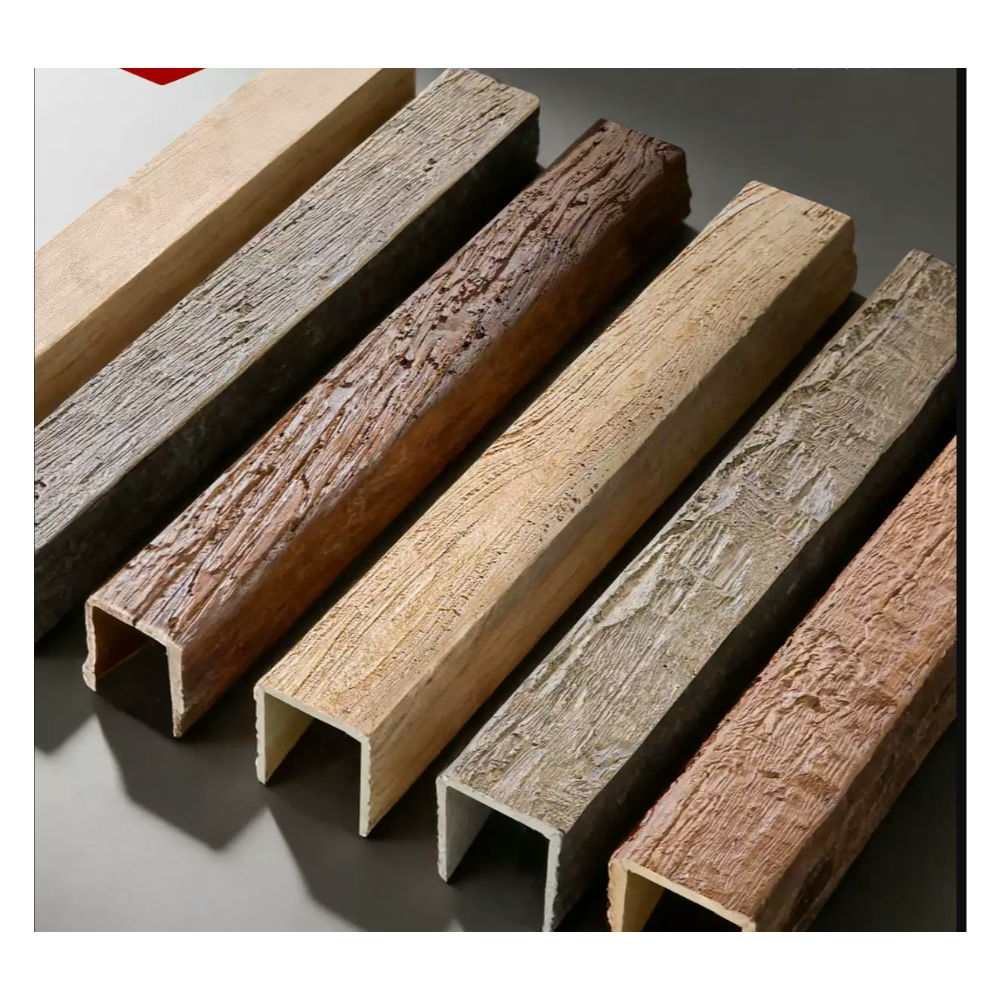
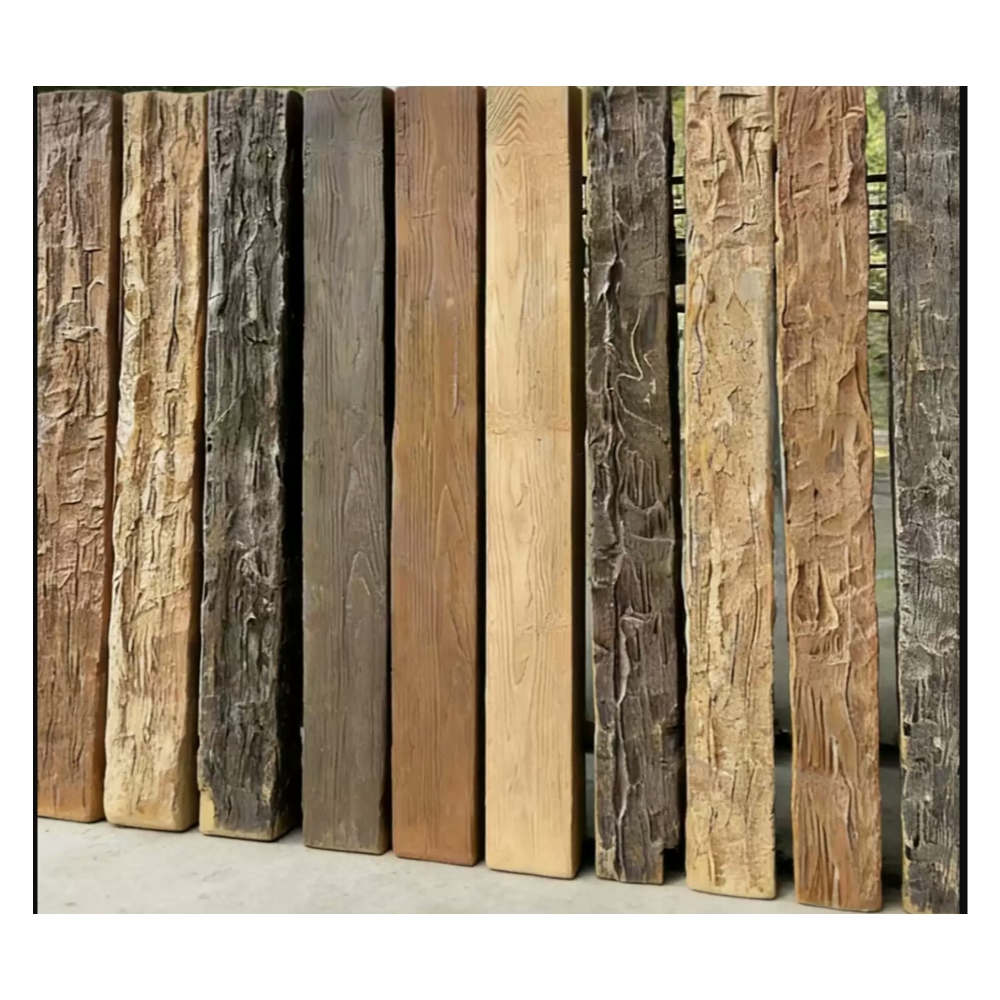
The finish carpenter installing crown molding in a custom home's great room encountered an unexpected alignment problem: the crown molding he was carefully fitting to decorative ceiling beams showed increasing gaps at beam intersections as installation progressed across the 40-foot room length. The gaps, ranging from 1/8 to nearly 3/8 inch, appeared despite precise cutting and fitting. Investigation revealed the cause: the solid red oak crown molding had been delivered to the jobsite three months earlier and stored in an unconditioned garage through a humid summer. The wood had absorbed moisture and expanded substantially—approximately 4% width increase from kiln-dried condition. Meanwhile, the polyurethane faux beams installed weeks earlier remained dimensionally stable regardless of humidity fluctuations. When the carpenter attempted to fit expanded wood trim to stable polyurethane beams using dimensions that assumed both materials were at equilibrium moisture content, the accumulated expansion created visible gaps. Remediation required removing installed crown, allowing wood to acclimate to interior conditions for six weeks, then reinstalling after dimensional stability was achieved. The delay cost three weeks of schedule and $8,500 in carpenter labor for removal, storage, and reinstallation.
Humidity-induced dimensional change in adjacent wood trim assemblies represents a material compatibility challenge that arises from fundamental differences in how wood and synthetic materials respond to moisture. Wood is hygroscopic—it absorbs and desorbs moisture from surrounding air in response to relative humidity changes, expanding when moisture increases and shrinking when moisture decreases. These moisture-driven dimensional changes can be substantial, often exceeding thermal expansion effects by an order of magnitude. Polyurethane and other synthetic materials remain essentially dimensionally stable across typical humidity ranges, neither absorbing significant moisture nor changing dimensions in response to humidity fluctuations. When ceiling assemblies combine wood trim elements with polyurethane beams, the differential moisture movement creates gaps, misalignment, or stress that proper material selection, seasoning, and joint detailing must accommodate.
Wood Moisture-Dimension Relationships
Wood dimensional behavior in response to moisture content changes follows well-documented relationships that allow predicting movement magnitudes.
Equilibrium moisture content (EMC) describes the moisture level that wood reaches when in long-term equilibrium with surrounding air conditions. EMC depends on relative humidity and temperature, with higher humidity producing higher EMC. Interior wood in climate-controlled buildings typically reaches EMC between 6% and 10% (moisture content as percentage of oven-dry wood weight) depending on local climate and seasonal variations. Exterior wood in humid climates may reach 12-16% EMC. Wood constantly adjusts toward EMC as humidity conditions change, though rate of adjustment depends on wood thickness, species, grain orientation, and finish systems that may retard moisture movement.
Dimensional change coefficient quantifies how much wood dimensions change per percent change in moisture content. Tangential shrinkage (perpendicular to growth rings in flat-sawn lumber) typically ranges from 0.15% to 0.35% per percent moisture content change depending on species. Radial shrinkage (parallel to growth rings in quarter-sawn lumber) runs approximately half tangential values. Longitudinal shrinkage (parallel to grain) is negligible at 0.01-0.02%, making length changes in wood trim much less significant than width or thickness changes.
Moisture content range in service represents the total MC variation that wood experiences throughout the year in particular applications. Well-controlled interior environments might see wood MC vary between 7% and 10%—a 3-percentage-point range. More variable interior environments or locations near moisture sources (bathrooms, kitchens) might experience 5-7 percentage point MC swings. For flat-sawn red oak crown molding (tangential shrinkage coefficient approximately 0.28% per %MC) experiencing 5 percentage point MC variation, total dimensional change reaches 0.28% × 5 = 1.4% of width. A 6-inch-wide molding would change dimension by 0.084 inches (approximately 5/64 inch) through moisture cycling—enough to create visible gaps if not accommodated.
Species-specific variation in dimensional stability ranges significantly. Among common trim species, mahogany and teak show excellent stability (low shrinkage coefficients), maple and birch show moderate stability, and oak and ash show relatively high movement. Species selection affects how much accommodation is required in assemblies combining wood with dimensionally stable materials.
Polyurethane Dimensional Stability
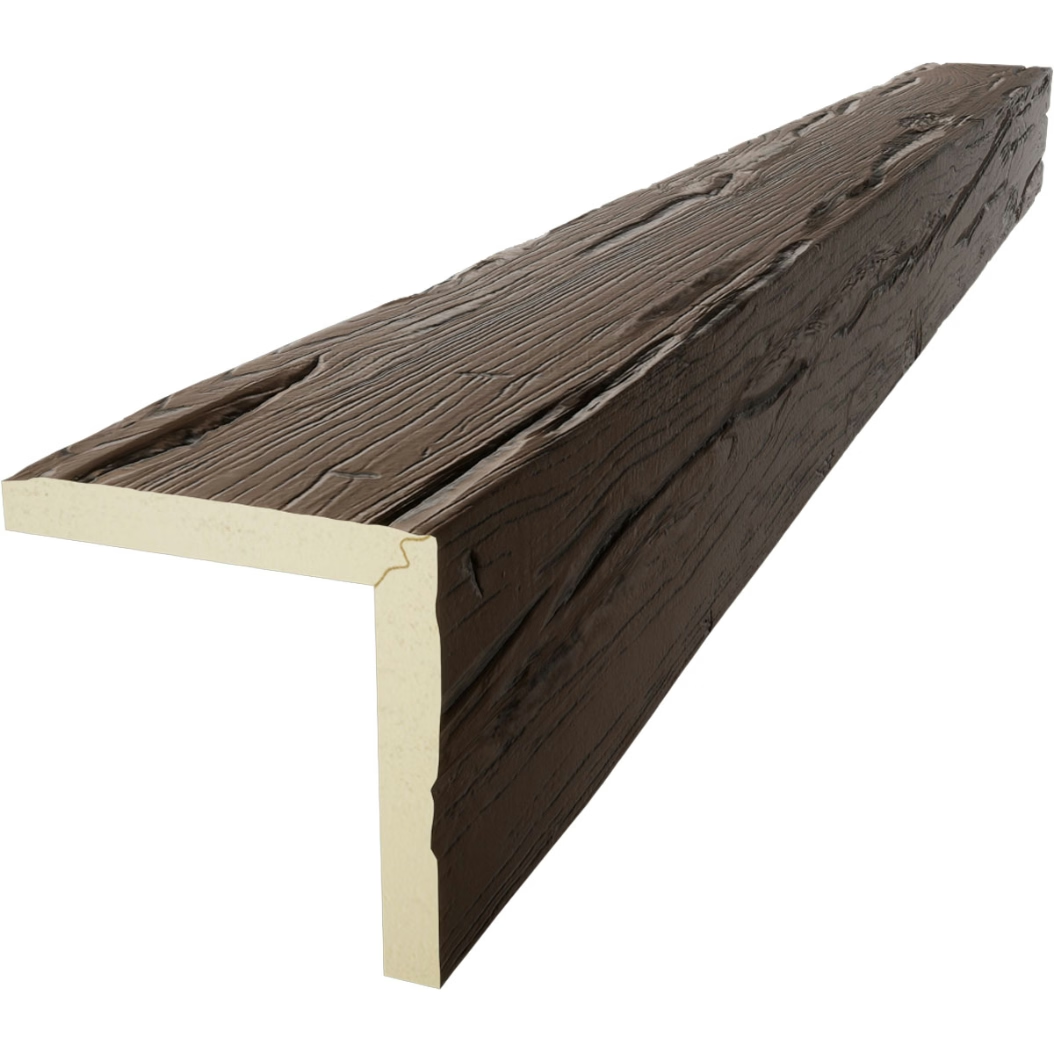
Polyurethane foam materials used in decorative beams exhibit fundamentally different moisture response compared to wood.
Moisture absorption in polyurethane foams is minimal across typical building humidity ranges. Closed-cell polyurethane formulations commonly used in beam products absorb less than 1% moisture by weight even at very high relative humidity (95% RH). This absorbed moisture has negligible effect on dimensions—polyurethane linear dimensions remain stable within 0.1% across full humidity ranges. This stability derives from polyurethane's polymer structure that lacks the hydroxyl groups and capillary structure responsible for wood's hygroscopic behavior.
Temperature effects on polyurethane dimensions exceed moisture effects substantially, as discussed in thermal expansion contexts. While wood dimensions respond primarily to moisture with modest thermal contribution, polyurethane responds primarily to temperature with negligible moisture contribution. This inverted relationship between materials complicates predicting which material will move more under particular environmental changes—outcome depends on whether humidity or temperature dominates the environmental variation.
Finish systems on polyurethane beams provide aesthetic effects but don't significantly affect dimensional stability because base material already exhibits minimal moisture response. In contrast, finish systems on wood—particularly film-forming finishes like polyurethane coatings or paint—significantly retard moisture movement rate though they don't eliminate dimensional change. These asymmetric effects of finishing mean that finished polyurethane beams and finished wood trim still exhibit substantially different moisture responses.
Long-term stability of polyurethane remains excellent barring severe degradation from UV exposure, extreme heat, or chemical attack. Wood dimensional behavior can evolve over decades as cell structure undergoes changes, but these effects are secondary to ongoing moisture cycling that drives most dimensional variation.
Predicting Differential Movement
Quantitative prediction of how wood and polyurethane elements will move differentially helps designers detail appropriate accommodation.
Environmental variation analysis establishes humidity ranges that wood will experience in specific applications. ASHRAE psychrometric data provides typical indoor humidity ranges for various climates and HVAC system types. Interior environments with good humidity control maintain 30-50% RH year-round, producing roughly 3 percentage point wood MC variation. Less-controlled environments might span 25-70% RH seasonally, creating 6-8 percentage point MC variation. Site-specific humidity monitoring in existing similar buildings provides most accurate data.
Wood dimensional change calculation uses species-specific shrinkage coefficients and predicted MC range. For 5-inch-wide cherry crown molding (tangential shrinkage 0.24%/%MC) experiencing 4 percentage point seasonal MC variation: dimensional change = 5 inches × 0.0024 × 4 = 0.048 inches (approximately 3/64 inch). While this appears modest, it accumulates along continuous trim runs and creates visible gaps where trim meets dimensionally stable beams if not accommodated.
Polyurethane dimensional stability can be assumed essentially zero for moisture-driven effects, simplifying analysis. All differential movement comes from wood component changes. This simplification makes predictions more reliable than situations where both materials move by different amounts in ways requiring complex interaction analysis.
Cumulative movement along extended assemblies represents critical consideration. A single beam-to-trim intersection might show only 1/16 inch gap from moisture movement—perhaps acceptable. However, a long wall with multiple beam-trim intersections might accumulate gaps totaling 1/4 inch or more if each intersection exhibits movement, creating obviously unacceptable appearance.
Acclimation Requirements
Proper wood acclimation before installation represents the most effective strategy for minimizing moisture-related problems.
Moisture content targets for interior trim installation typically specify 6-8% MC depending on local climate and expected service conditions. Wood should acclimate to within 2 percentage points of expected service EMC before installation. Some specifications require even tighter tolerances (±1 percentage point) for critical applications where dimensional stability is paramount. These targets ensure that major dimensional adjustment occurs before installation rather than after, minimizing movement in service.
Acclimation duration depends on wood thickness, initial moisture condition, and storage environment. Thin trim stock (3/4 inch and less) may acclimate adequately in 2-4 weeks if stored in controlled interior conditions. Thicker stock or material stored in unconditioned spaces may require 6-8 weeks or longer to reach equilibrium. Moisture meter measurements at weekly intervals verify when acclimation is complete—readings should stabilize at target MC before installation proceeds.
Storage conditions during acclimation should match expected service environment as closely as practical. Wood intended for climate-controlled interiors should acclimate in similarly controlled spaces, not in garages, outdoor sheds, or unconditioned warehouses. Stacking practices should allow air circulation around all surfaces—stickering between boards, avoiding plastic wrapping that traps moisture, and providing space between stacks and walls.
Supplier moisture content at delivery varies widely and should be verified rather than assumed. Wood marketed as "kiln-dried" may be 8-10% MC or may be 12-15% depending on supplier practices and storage conditions. Long-distance shipments through varying climates may arrive at different MC than existed at manufacturing. Moisture meter verification at delivery determines whether received wood requires further acclimation or is ready for installation.
Joint Design for Movement Accommodation
Architectural details connecting wood trim to polyurethane beams should accommodate anticipated differential movement without visible damage.
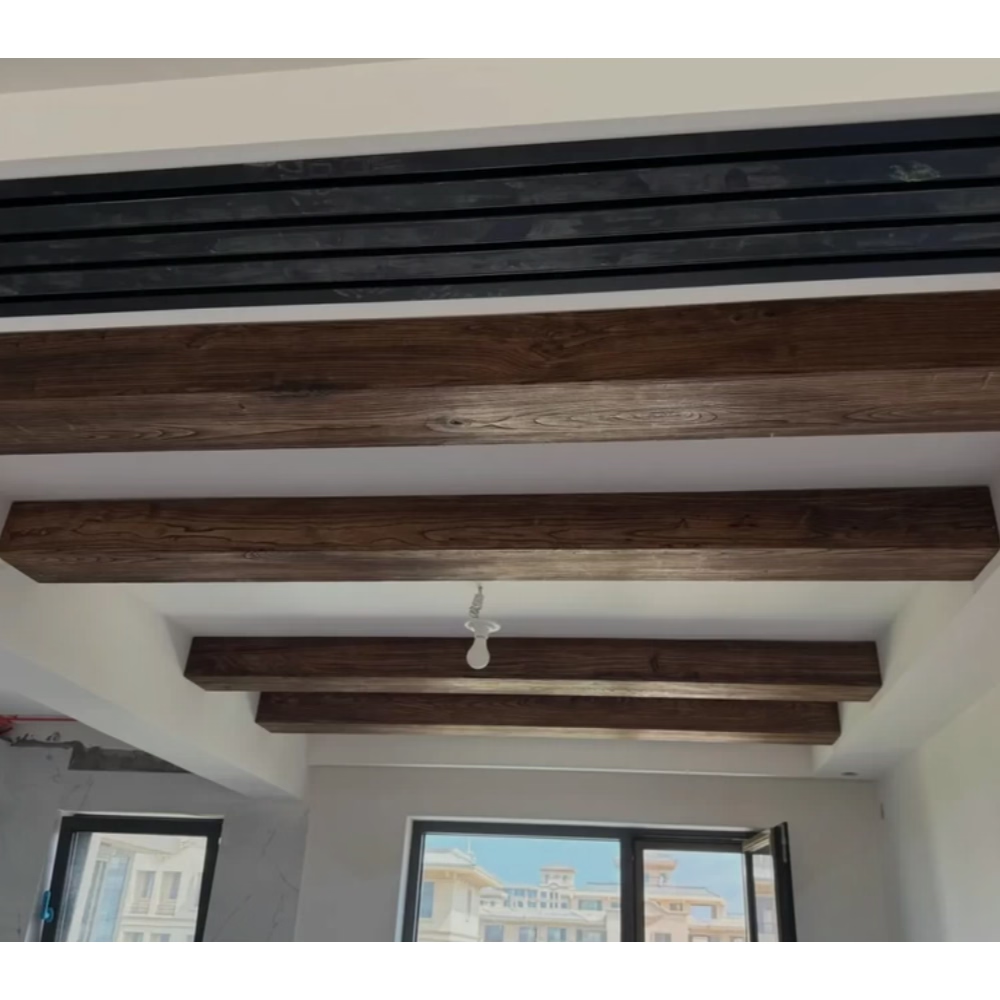
Reveal joints separating wood and polyurethane elements with deliberate gaps provide movement accommodation through gap width variation. A 1/8-inch reveal designed into the joint between crown molding and beam allows the gap to vary between 1/16 inch and 3/16 inch as wood expands and contracts, maintaining some visible reveal throughout moisture cycles rather than alternating between tight joint and obvious gap. Reveal dimensions should be selected based on predicted wood movement magnitude plus aesthetic considerations about appropriate visual separation.
Flexible sealant in joints allows maintaining apparent continuity while accommodating movement. Color-matched silicone or urethane sealants applied in joints between wood and polyurethane bond to both materials while stretching and compressing as dimensions change. Sealant selection should specify movement capability (typically ±25% to ±50% of joint width) adequate for predicted wood dimensional changes. Initial joint width during sealant installation should position wood at mid-range MC, allowing equal movement capacity for expansion and contraction.
Mechanical fastening strategies affect whether joints accommodate movement or develop stress. Fasteners driven through wood trim into polyurethane beams should allow wood to move relative to polyurethane—either by using oversized holes in wood (allowing sliding), by limiting fastener penetration depth (allowing wood to pull away slightly), or by using flexible mounting clips rather than rigid screws. Over-constrained joints prevent movement, causing internal stress that can crack wood or pull fasteners through polyurethane.
Overlapping joint configurations where one material laps over another with flexible interface can conceal movement while allowing it to occur. Wood trim pieces lapping over polyurethane beam edges with construction adhesive applied only at overlap centers permit edge areas to flex as wood expands and contracts. This detail maintains visual appearance of tight joints while providing movement accommodation through elastic deformation of overlap areas.
Species and Grade Selection
Strategic wood species and grade selection can minimize moisture-driven dimensional changes and their impacts.
Dimensionally stable species including mahogany, teak, vertical-grain Douglas fir, and quartersawn oak show lower moisture movement than species like plain-sawn red oak, ash, or hickory. Where visual requirements permit species selection flexibility, specifying stable species reduces accommodation demands. Premium cost for stable species ($8-15 per lineal foot versus $4-7 for standard species in typical trim profiles) may be justified by reduced installation complexity and better long-term performance.
Quartersawn versus plain-sawn grain orientation dramatically affects movement magnitude in many species. Quartersawn lumber exhibits radial shrinkage (typically 50% of tangential values), meaning roughly half the dimensional change of plain-sawn material. Specifying quartersawn trim where possible provides stability benefits, though availability may be limited and cost typically runs 40-60% premium over plain-sawn material.
Select grade lumber with minimal knots and straight grain shows more predictable and uniform movement compared to lower grades with knots, cross-grain, or other defects that create localized variation. While select material costs more ($6-10 per lineal foot versus $3-5 for standard grades), the improved uniformity helps ensure that predicted movement actually occurs rather than having unexpected local variations.
Engineered wood products including MDF, finger-jointed lumber, and some composite materials show improved dimensional stability compared to solid wood, though not matching polyurethane stability. These products average out natural wood variability and may incorporate adhesives that reduce moisture response. However, aesthetic considerations often rule out engineered products for high-end applications where solid wood appearance is required.
Installation Sequencing Strategies
The sequence in which wood trim and polyurethane beams install affects how well assemblies accommodate differential movement.
Beam installation before trim installation allows establishing fixed references to which wood trim must adjust. This sequence requires that wood be at or near final MC before trim installation begins—otherwise wood continues adjusting after installation, creating gaps at beam interfaces. The advantage is that beams provide stable references that won't move, simplifying trim cutting and fitting.
Trim installation before beam installation allows wood to complete major dimensional adjustment before adding beams that must accommodate to wood position. This sequence works well if trim can be installed early enough to observe through at least one seasonal cycle, confirming dimensional stability before beam installation proceeds. However, schedule considerations often preclude such lengthy observation periods.
Simultaneous installation of beams and trim requires careful coordination and typically results in compromised accommodation of movement. Unless both materials are at equilibrium MC during installation and environment remains stable thereafter (unrealistic in most cases), subsequent differential movement creates gaps somewhere in assemblies. This approach should be avoided unless project constraints provide no alternative.
Delayed final fitting where trim installs initially with deliberate oversize gaps, then final-fitted after wood completes acclimation, provides robust movement accommodation at cost of requiring two installation mobilizations. Initial installation secures trim in place with gaps 1/4 inch or larger. After months of acclimation confirming dimensional stability, carpenters return to final-fit joints to proper dimensions. The approach nearly eliminates moisture movement problems but increases labor cost through two site visits and may not be acceptable for occupied buildings where finish appearance matters from completion.
Monitoring and Adjustment
Post-installation monitoring helps identify whether assemblies are performing as designed or developing problems requiring adjustment.
Moisture content monitoring using resistance or pin-type moisture meters tracks wood MC over time, confirming whether material has reached stable equilibrium or continues gaining/losing moisture. Measurements at monthly intervals for the first year after installation provide valuable data about seasonal MC variation and whether wood reached expected EMC. Readings substantially different from predictions indicate conditions requiring investigation—perhaps humidity control systems aren't performing as expected, or water infiltration is affecting materials.
Joint gap measurement documents actual movement magnitudes, allowing comparison against predictions and determination of whether accommodation provisions are adequate. Photographs taken at seasonal extremes (peak heating season and peak cooling season) provide permanent records showing maximum and minimum gap dimensions. Measurements exceeding predicted values indicate that either wood moisture movement is greater than anticipated or accommodation details aren't functioning as designed.
Stress indicators including cracking in wood, pulled fasteners, or distortion in assemblies signal that movement accommodation is inadequate. These problems require investigation to determine root cause—excessive wood movement magnitude, inadequate accommodation capacity in details, or unexpected restraint preventing designed movement from occurring. Early detection through monitoring allows corrective action before problems become severe.
Humidity control system performance should be verified through space humidity monitoring, particularly if wood movement problems develop. If HVAC systems aren't maintaining expected humidity ranges, wood will experience larger MC variation than design assumed. System adjustments or upgrades may be necessary to achieve humidity control adequate for dimensional stability requirements.
Case Study: Great Room Crown Molding
The custom home project described in the opening provides detailed example of moisture movement problem diagnosis and resolution.
Material testing of stored crown molding found MC ranging from 13% to 15%—far above the 7-8% EMC expected in the home's climate-controlled interior. Wood had clearly absorbed substantial moisture during summer storage in an unconditioned garage. Calculation predicted that adjusting from 14% MC to 7% EMC would cause shrinkage of approximately 0.24% × 7 = 1.68% in width. For 5-inch-wide crown profile, this represented 0.084 inch (approximately 5/64 inch) shrinkage—enough to create visible gaps when fit to dimensionally stable polyurethane beams.
The decision to remove installed crown and allow proper acclimation rather than attempting remedial gap-filling was based on recognition that wood would inevitably shrink as it dried to interior EMC. Any gap filling or caulking performed while wood remained swollen would fail as shrinkage occurred, requiring re-work anyway. Allowing proper acclimation before reinstallation ensured long-term dimensional stability.
Acclimation monitoring measured MC weekly over six-week period, with crown stored horizontally stacked with stickers in the conditioned house interior. Initial MC of 14% dropped to 11% after two weeks, 9% after four weeks, and stabilized at 7.5-8% after six weeks—matching expected EMC for the local climate and confirming acclimation was complete.
Reinstallation incorporated 1/8-inch reveal joints at crown-to-beam intersections, providing accommodation for future moisture cycling. Even with wood at proper MC during installation, seasonal humidity variation would cause some ongoing dimensional change. The reveal joints allowed gap width to vary between 1/16 inch and 3/16 inch through seasonal cycles without creating appearance of gaps developing from shrinkage.
Post-installation monitoring over the first year confirmed successful performance. Wood MC ranged from 6.5% to 8.5% seasonally—roughly 2 percentage point variation producing dimensional change of approximately 0.024 inches (about 1/32 inch). The reveal joints accommodated this movement while maintaining acceptable appearance throughout the year. No stress-related cracking or joint failures developed, indicating that accommodation provisions were adequate for actual service conditions.
Cost analysis showed that proper initial material acclimation would have cost approximately $800 in storage fees at a climate-controlled warehouse for three months versus the $8,500 spent on removal and reinstallation after problems developed. The case exemplifies how relatively small investments in proper material conditioning prevent substantially larger remediation expenses while delivering better long-term performance.
Humidity-induced dimensional change in adjacent wood trim assemblies exemplifies how material science fundamentals directly impact architectural detail performance. Wood and synthetic materials respond to environmental conditions in fundamentally different ways—wood dimensions driven primarily by moisture content, synthetics driven primarily (if at all) by temperature. Assemblies combining these materials must accommodate differential movement through appropriate joint design, proper material conditioning, and careful installation practices. Projects that understand these material behavior differences and detail accommodation accordingly create assemblies that maintain acceptable appearance and function through years of environmental cycling. Those that ignore moisture-dimension relationships discover problems after completion when remediation costs substantially more than proper initial material selection, acclimation, and joint design would have required. The hygroscopic nature of wood represents a fundamental material characteristic that architectural detailing must address rather than ignore.
Technical References
ASTM standards cited in every specification
Test Data
Lab results from internal testing program
Updated 2026
Reviewed against current product specs