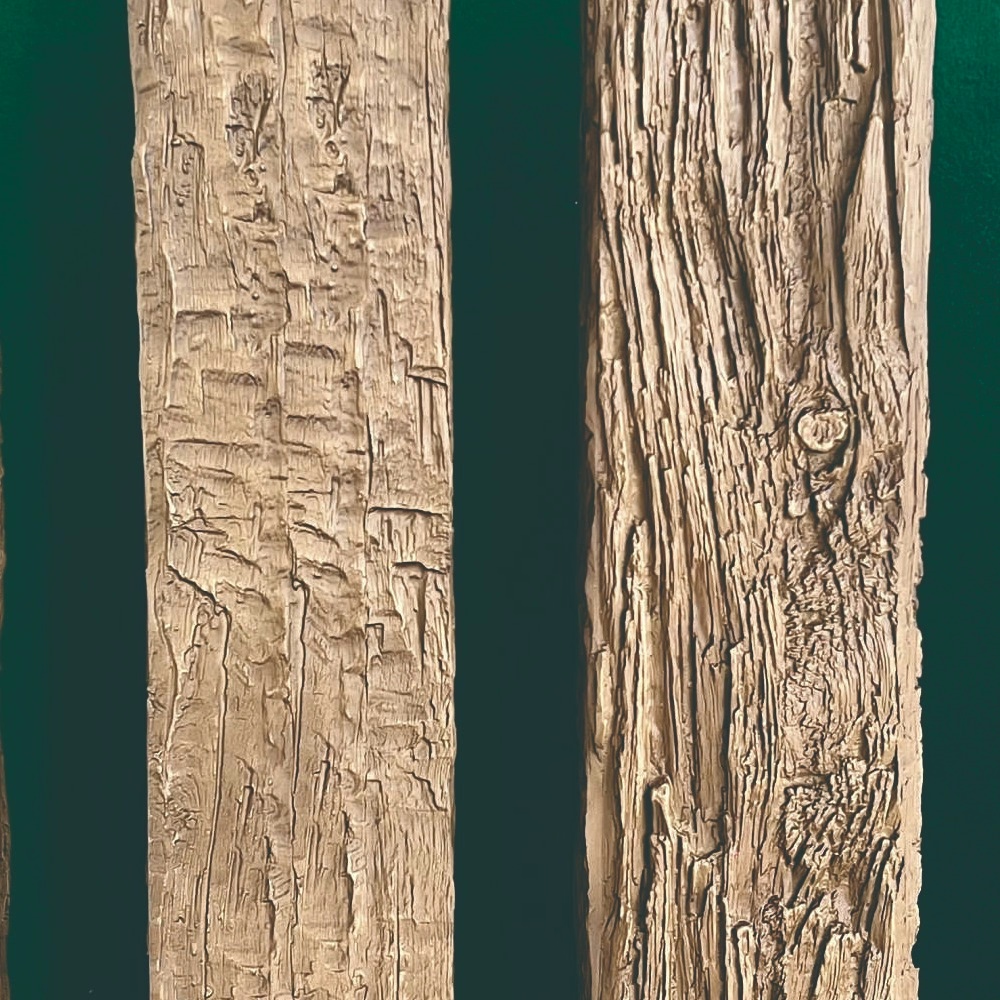
The warranty claim seemed straightforward—fifteen beams across three hotel properties showed premature surface degradation after only two years. But determining which production batch the affected beams came from, whether other properties received materials from the same batch, and whether raw material defects or process variations caused the problem required three weeks of detective work through incomplete records. The investigation revealed that our purchasing system tracked orders and deliveries but couldn't trace individual beams back to production lots or forward to specific installation locations. That documentation gap cost us time, money, and credibility with a frustrated client.
Supply chain traceability—the ability to track products from raw materials through production, distribution, and installation—transforms from nice-to-have documentation to essential business system when projects involve thousands of beams across multiple sites delivered over months. Modern traceability systems provide rapid problem identification, targeted recalls, warranty claim verification, and continuous improvement insights that justify the infrastructure investment they require.
Understanding Traceability Requirements
Forward traceability tracks products from production through distribution to final installation locations. This capability allows manufacturers discovering production defects to identify exactly which customers received potentially affected materials and where those products installed. Without forward traceability, manufacturers face choosing between costly universal recalls affecting all customers during suspect timeframes or ignoring problems and accepting liability for unaddressed defects.
Backward traceability links installed products to production batches, raw material lots, and process conditions. When field problems arise, backward traceability enables investigating root causes by connecting finished product performance to manufacturing details. This investigative capability supports continuous improvement by identifying process variations, material quality issues, or handling problems that create defects.
Horizontal traceability connects products across the supply chain at specific points in time—relating production batches to raw material lots, equipment usage, environmental conditions, and personnel. This multidimensional tracking enables sophisticated root cause analysis that single-dimension traceability can't support. Understanding that a surface finish problem correlates with a specific pigment lot used during humid weather on one production line creates actionable improvement opportunities.
Granularity levels determine traceability usefulness. Unit-level tracking identifying individual beams provides maximum capability but requires extensive data infrastructure. Batch-level tracking grouping materials produced under common conditions offers practical balances between capability and complexity. For polyurethane beams, production run or daily batch tracking typically provides adequate granularity for quality management while remaining implementable.
Traceability speed affects practical utility. Systems providing real-time access to traceability data enable rapid response to emerging issues. Manual systems requiring days to compile information from paper records delay responses when timing matters. Web-based traceability portals allowing customers to query product lineage deliver maximum value with minimal overhead once implemented.
Production-Level Tracking Systems
Batch numbering schemes encode production information enabling rapid identification of manufacturing conditions. Effective numbering systems incorporate production date, line number, shift, and sequential batch identifiers within compact codes. A code like "26J12A1847" might indicate 2026, January 12th, A shift (day shift), line 1, batch 847. This encoding allows anyone reading the number to immediately understand when and where production occurred without accessing databases.
Raw material lot tracking links finished products to specific raw material batches, enabling investigation when material quality issues arise. Polyurethane foam results from reacting several chemical components—resin, isocyanate, catalyst, pigments, and additives. Recording which lots of each component went into specific production batches allows investigating whether finished product variations correlate with raw material changes.
Process parameter recording captures machine settings, environmental conditions, and cycle times affecting product characteristics. While not strictly traceability, linking process data to batch identifiers enables correlating field performance with production conditions. This capability proves invaluable when troubleshooting subtle quality issues that only become apparent after installation.
Equipment identification within batch records helps isolate problems to specific production assets. If one mold produces beams with slight dimensional variations, linking production batches to specific molds enables targeted corrective action. Similarly, if one production line creates surface finish issues, equipment-level traceability focuses investigation appropriately.
Operator identification within traceability systems balances accountability with privacy concerns. Recording which crews operated equipment during specific batches helps identify training needs or process understanding gaps affecting quality. Some organizations resist operator-level tracking due to privacy concerns or labor relations considerations, finding acceptable compromises through shift-level rather than individual-level identification.

Packaging and Labeling Systems
Individual beam identification through labels, embossing, or marking creates unit-level traceability foundations. Adhesive labels applied during production carry batch numbers, production dates, and product specifications. These labels must withstand handling and remain legible through distribution and installation. Alternatively, embossing batch codes into beam ends provides permanent identification immune to label damage but requires reading codes on-site.
Bundle packaging labels aggregate individual beam information at shipping unit levels. Bundles typically contain 6-12 beams packaged together for handling and transportation. Bundle labels carry batch numbers, quantity, product specifications, and destination information. These aggregated labels simplify logistics tracking while maintaining traceability linkage to individual components.
Pallet manifests document all bundles on shipping pallets, creating hierarchical traceability from pallets to bundles to individual beams. Manifest documentation allows warehouse personnel to locate specific batches without unwrapping pallets. Digital manifests linked to warehouse management systems enable real-time inventory visibility supporting efficient order fulfillment.
Barcode and QR code technologies enable rapid data capture eliminating manual transcription errors. Scanning batch codes during production, warehousing, shipping, and receiving updates traceability databases automatically. Modern smartphone apps can read QR codes containing batch information, product specifications, and links to online documentation, putting comprehensive product data instantly at users' fingertips.
RFID tag implementation provides automated tracking as tagged products move through facilities. RFID readers at production lines, warehouse exits, loading docks, and receiving areas capture product movement without manual scanning. While more expensive than barcode systems, RFID reduces labor requirements while improving tracking accuracy. Cost-benefit analysis determines whether RFID investment justifies benefits for specific operations.
Logistics and Distribution Tracking
Shipment documentation linking orders to specific batches creates essential traceability connections between production and delivery. Bills of lading, packing lists, and shipping manifests should reference batch numbers, allowing field installers and building managers to know exactly which production runs they received. This documentation proves critical when investigating field problems or managing recalls.
Chain of custody records document product handling from factory to job site, particularly important for projects requiring specific storage conditions or handling protocols. Temperature-sensitive materials, items requiring covered storage, or products with handling restrictions benefit from documented custody transfers proving proper care throughout distribution.
Geographic distribution patterns revealed through traceability data help optimize logistics while supporting quality investigations. Understanding which regions receive materials from which plants or production runs allows investigating whether geographic factors—climate, transportation mode, handling practices—affect field performance. This analysis sometimes reveals problems that appear to be manufacturing defects but actually result from distribution or handling issues.
Delivery confirmation systems using electronic proof of delivery provide timestamps and location data closing traceability chains from production to installation. Knowing exactly when materials arrived at job sites helps distinguish manufacturing problems from field handling issues. Materials performing poorly might correlate with extended site storage under poor conditions rather than production defects.
Temperature and environmental monitoring during transportation protects material quality while creating data supporting quality investigations. Some sensitive materials require temperature-controlled shipping. Even materials without explicit temperature requirements might degrade under extreme conditions. Recording transit environments provides data explaining field performance variations while verifying that shipping conditions met requirements.

Installation and Project-Level Documentation
Material receiving logs at job sites create critical traceability links between delivered materials and installation locations. Site superintendents or receiving clerks noting batch numbers, quantities, and receiving dates in project records enables tracking specific batches to buildings, floors, or rooms where they installed. This documentation proves essential for warranty claims or investigating localized performance issues.
Installation mapping documents which batches installed in which locations, creating the final traceability linkage from production through to specific building areas. For hotels, this means knowing which guest rooms received beams from which batches. For retail chains, tracking which stores received which production runs. This granular location tracking enables targeted investigation and remediation when problems arise.
Photographic documentation showing batch labels before installation creates permanent records surviving label removal during installation. Many installation processes remove or obscure product labels—photographing labels before coverage preserves information otherwise lost. Digital photography with GPS and timestamp metadata provides robust documentation requiring minimal effort.
As-built documentation incorporating material traceability information supports facility management throughout building lifecycles. Building information management (BIM) systems can integrate material batch numbers, installation dates, and manufacturer information, creating comprehensive facility databases. This integration allows building managers decades later to understand exactly what materials exist in their buildings when planning renovations or investigating issues.
Warranty registration systems linking installed products to owners, installation dates, and traceability data streamline warranty claim processing while providing manufacturers with field performance feedback. Rather than requiring building owners to dig through old paperwork proving purchase dates and warranty coverage, manufacturers with robust warranty registration systems can verify coverage immediately while accessing traceability data supporting claim investigation.
Quality Issue Investigation and Response
Problem identification triggers begin traceability investigations. Field reports of performance issues, warranty claims, or installer feedback suggesting problems initiate looking at which batches are involved and whether patterns exist. Early problem detection through complaint tracking systems allows addressing issues before widespread field failures occur.
Batch correlation analysis determines whether field problems concentrate in specific production runs or distribute across all production. If problems cluster in particular batches, manufacturing variations likely caused issues. If problems appear randomly across batches, field conditions, installation practices, or application mismatches might be responsible. This distinction fundamentally affects appropriate responses.
Affected product identification using traceability data determines recall or remediation scope. Rather than blanket recalls affecting all products within broad timeframes, precise traceability identifies exactly which batches require attention. This precision dramatically reduces recall costs while ensuring that all potentially affected products receive appropriate attention.
Customer notification processes leverage traceability data to contact only affected customers with specific information about which products they received and what actions are necessary. Targeted communication prevents unnecessary alarm among unaffected customers while providing actionable information to those genuinely impacted. Communication speed and accuracy directly affect customer satisfaction during problem resolution.
Remediation tracking documents problem resolution for quality records and liability protection. Recording which affected products were replaced, repaired, or verified as acceptable creates audit trails proving appropriate responses. This documentation proves essential defending against later claims that manufacturers inadequately addressed known problems.
Continuous Improvement and Data Analytics
Trend analysis across production batches reveals subtle quality drifts before they create field problems. Statistical analysis of measurements from sequential batches might show gradual dimensional changes indicating tool wear. Color measurements trending toward specification limits suggest process adjustments needed before out-of-specification production occurs. These predictive insights allow corrective action preventing problems rather than just detecting them.
Correlation studies linking field performance to production variables identify process parameters most affecting quality. If beams from batches produced during low-humidity periods show better long-term performance, process adjustments might maintain humidity levels more carefully. These insights transform manufacturing from reactive problem-solving to proactive optimization.
Supplier performance evaluation using traceability data connecting raw material lots to finished product quality holds material suppliers accountable for consistency. If problems correlate with specific material lots, data documenting the relationship supports supplier discussions about improvement. Similarly, good performance from particular material lots recognizes excellent supplier quality.
Process optimization opportunities revealed through traceability analysis justify continuous improvement investments. Understanding that specific production line configurations, temperature settings, or cycle times produce superior results allows standardizing best practices across all production assets. The performance improvement often exceeds implementation costs substantially.
Customer feedback integration with traceability creates closed-loop quality systems linking field performance to manufacturing details. Customer satisfaction surveys or complaint reports referencing product batch numbers enable correlating satisfaction with production variables. This linkage identifies which manufacturing approaches deliver best customer outcomes beyond just meeting specifications.
Regulatory Compliance and Certification Support
Building code documentation requirements for some applications demand material traceability proving that installed products meet specifications. Fire-rated assemblies, structural components, or materials in regulated occupancies may require documentation proving specific products were used. Traceability systems generate this documentation efficiently.
Green building certifications including LEED require material documentation proving recycled content, regional sourcing, or low-VOC formulations. Traceability linking installed products to production batches with specific material compositions provides verifiable documentation supporting certification claims. Without traceability, generating required documentation becomes labor-intensive or impossible.
Product recall management demands rapid identification of affected products and customers to satisfy regulatory requirements. Consumer Product Safety Commission or equivalent agencies require manufacturers discovering safety issues to notify affected parties promptly. Traceability systems providing this information within hours rather than weeks demonstrate due diligence while protecting consumers.
Liability protection through comprehensive traceability documentation demonstrates that manufacturers maintained appropriate quality systems and responded properly to identified issues. In litigation, documentation proving systematic quality management and appropriate responses to problems often determines liability outcomes. Robust traceability creates this protective documentation as a normal business process.
Technology Infrastructure and Implementation
Database architecture supporting traceability must balance accessibility, security, and performance. Cloud-based systems offer access from multiple locations supporting distributed operations. Adequate security prevents unauthorized access to proprietary manufacturing data. Database performance supporting rapid queries ensures traceability provides useful information quickly rather than eventually.
Integration with enterprise systems including ERP, MES, and WMS creates automated data flow eliminating manual transcription errors. Production management systems automatically record batch numbers, materials consumed, and process parameters. Warehouse systems capture inventory movements and shipments. ERP systems link orders to shipments to invoices. Integration connects these data sources creating comprehensive traceability without duplicate data entry.
Mobile access through smartphone apps brings traceability capability to field personnel. Installers photographing batch labels automatically upload to central databases. Quality inspectors accessing batch history on job sites verify materials meet specifications. This mobile capability extends traceability from offices to wherever products exist.
User interface design determines whether traceability systems deliver value or sit unused. Intuitive interfaces enabling rapid information access encourage adoption. Complex systems requiring extensive training remain underutilized. Interface design should prioritize common queries—tracking forward from batches, tracing backward from locations, and correlation analysis—making these functions simple.
Cost-Benefit Analysis and ROI
Implementation costs including software licensing, hardware, training, and process changes require justification through benefit quantification. Small operations might implement basic traceability using spreadsheets and manual processes at minimal cost. Large operations might invest six figures in integrated systems capturing comprehensive data automatically. Appropriate investment levels depend on order volumes, product complexity, and risk exposure.
Recall cost reduction provides measurable benefits. A targeted recall affecting 5% of production costs dramatically less than blanket recalls affecting 100% of production during suspect timeframes. The ability to precisely identify affected products creates direct, quantifiable savings during each recall event.
Warranty claim efficiency improves when traceability enables rapid claim validation and root cause identification. Rather than arguing about whether products were defective or whether customers installed them properly, traceability data often reveals clear answers. This efficiency reduces claim processing costs while improving customer satisfaction.
Quality improvement ROI from insights enabled by traceability analysis can exceed system costs substantially. If traceability reveals process optimizations reducing scrap 2%, material savings alone might justify system investments. Similarly, improvements reducing warranty claims create ongoing savings far exceeding initial implementation costs.
Risk mitigation value through liability protection, regulatory compliance, and reputation management proves difficult to quantify but remains substantial. Companies without adequate traceability facing product liability claims or regulatory action sometimes experience existential threats. Robust traceability systems provide insurance against these scenarios.
Building a Traceability Culture
Organizational commitment from leadership establishes traceability as business priority rather than quality department hobby. When executives emphasize traceability importance and hold organization accountable for maintaining data quality, systems succeed. Without leadership support, traceability initiatives often stall amid competing priorities and resource constraints.
Training programs ensure personnel understand traceability importance and their roles in maintaining system integrity. Production operators labeling products correctly, warehouse workers scanning shipments accurately, and installers documenting batch information at job sites all contribute to traceability effectiveness. Training communicates why their contributions matter and how they support broader quality objectives.
Data quality management through validation, periodic audits, and correction procedures maintains traceability integrity. Systems containing inaccurate data become liabilities rather than assets—incorrect traceability worse than no traceability because it creates false confidence. Regular data audits identify discrepancies for correction while validating overall system accuracy.
Continuous improvement of traceability systems themselves ensures they evolve meeting changing business needs. As operations grow, product lines expand, or regulatory requirements change, traceability systems must adapt. Periodic reviews identifying enhancement opportunities keep systems relevant and valuable.
Strategic Value Creation
Supply chain traceability for high-volume polyurethane beam orders transforms from compliance checkbox to strategic asset when properly implemented. The ability to track products from raw materials through installation enables rapid problem resolution, supports continuous improvement, protects against liability, and builds customer confidence. While requiring investment in systems and processes, the returns through reduced costs, improved quality, and risk mitigation justify implementation for operations of any significant scale.
For manufacturers, distributors, and large contractors managing substantial product volumes across multiple projects, developing robust traceability capabilities separates professional operations from those flying blind through supply chains. The discipline to capture and maintain traceability data creates competitive advantages while protecting organizations against increasingly complex quality, regulatory, and liability landscapes.
Technical References
ASTM standards cited in every specification
Test Data
Lab results from internal testing program
Updated 2026
Reviewed against current product specs